We present this work in honor of the 405th anniversary of the poet’s death.
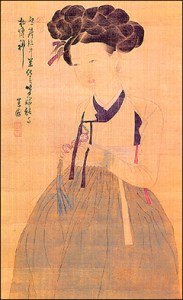
Heo Gyun Korean 1569 – 1618
As the sun is about to set, An old woman is wailing in the ruins of a village. Her disheveled hair looks as if blighted by frost, And her eyes are shadowed as if by dusk. Her husband is in a cold jail cell, Because he cannot pay off the money he owes, And her son has gone off with the royal army. Her house has been burned down to the base of the pillars; Hiding out in the woods she has lost even her hemp petticoat. She has no work, she has no wish even to go on living, Why is the petty clerk of the district calling for her at the gate?
We present this work in honor of the 445th anniversary of the poet’s death.
Francisco de Aldana Spanish 1537 – 1578
A thousand times I say, in Galatea’s arms, that she’s more lovely than the sun; then she, with a sweet look, disdainfully, tells me, “My Tyrsis, do not tell me that.”
I try to swear it, and she, suddenly, her face now blazing with a rosy hue restrains me with a kiss and hastily my words with her own lips seeks to combat.
I struggle with her mildly to break free, and she holds me more tightly and then says, “Don’t swear, my love, I know it’s not a lie.”
With this she so completely shackles me that Love, a witness to our gentle play, causes with deeds my hope to satisfy.
Surely she does not lack beauty Nor skills in sewing and weaving. But she grew up in a poor family So good matchmakers ignore her.
She never looks cold or hungry, All day long she weaves by her window. Only her parents feel sorry for her; Neighbors would never know of it.
A pair of golden scissors in her hand, Fingers stiffened by the night’s chill. She cuts a bridal costume for another, Yet year after year she sleeps alone.
We present this work in honor of the 490th anniversary of the poet’s death.
Ludovico Ariosto Italian 1474 – 1533
Upon two beauteous images below Each of these female statues fix their feet. The lower seem with open mouth to show That song and harmony to them are sweet; And, by their attitude, ’twould seem, as though Their every work and every study meet In praising them, they on their shoulders bear, As they would those whose likenesses they wear.
The images below them in their hand Long scrolls and of an ample size contain, Which of the worthiest figures of that band The several names with mickle praise explain As well their own at little distance stand, Inscribed upon that scroll, in letters plain, Rinaldo, by the help of blazing lights, Marked, one by one, the ladies and their knights.
The first inscription there which meets the eye Recites at length Lucretia Borgia’s fame, Whom Rome should place, for charms and chastity, Above that wife who whilom bore her name. Strozza and Tebaldeo—Anthony And Hercules—support the honoured dame: (So says the scroll): for tuneful strain, the pair A very Linus and an Orpheus are.
A statue no less jocund, no less bright, Succeeds, and on the writing is impressed; Lo! Hercules’ daughter, Isabella hight, In whom Ferrara deems her city blest, Much more because she first shall see the light Within its circuit, than for all the rest Which kind and favouring Fortune in the flow Of rolling years, shall on that town bestow.
The pair that such desirous ardour shew That aye her praises should be widely blown: John James alike are named: of those fair two, One is Calandra, one is Bardelon. In the third place, and fourth, where trickling through Small rills, the water quits that octagon, Two ladies are there, equal in their birth, Equal in country, honour, charms and worth.
Green water, do not boast of your rapid flow from the blue mountains. It is hard to return when you’ve reached the blue sea. A full moon graces these peaceful hills: Won’t you rest a while?
The sun, upon a cliff its bright rays beaming, Trickles the melting snow; and so my lot As well: I too melt when I feel the hot Gentleness of your flame upon me gleaming.
My weeping eye becomes a brooklet, streaming; And my soul, vanquishing my flesh, vows not Again to bend itswill—nay, not one jot— To seek out vice or be full wayward-seeming.
But let your fire desist, leaving me lost, And cold my heart grows, frozen more than frost Of frigid winter’s day, white as the snows.
Dear Lord, I pray you not abandon me! Return, else eath must be my destiny: I live but by that gift your grace bestows.
We present this work in honor of the 410th anniversary of the poet’s death.
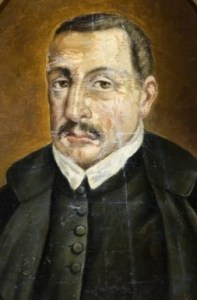
Lupercio Leonardo de Argensola Spanish 1559 – 1613
Frightful representation of death, cruel sleep, my heart no longer agitate, by showing me the tight knot has been cut, sole consolation for my adverse fate.
Seek out the ramparts of some tyrant strong, his walls of jasper, ceiling made of gold; or seek the miser rich in his poor bed, and make him wake up sweating, trembling, cold.
Then let the first see how the angry mob breaks down with wrath his iron-covered gates, or see the hidden blade of lackey bought;
and let the second see his wealth exposed by stolen key or furious assault: and let Love keep the glories he has wrought.
O shepherdess, my friend, On love alone I live. True love is life’s true end, My heart can comprehend, And therefore I intend My love unceasingly to give. O shepherdess, my friend, On love alone I live.
Love lends me confidence, Grants conscience calmer sense, Builds patient competence, Forms faith and hope restorative; O shepherdess, my friend, On love alone I live.
Love is my victory, Honor, gleaming glory; Fashions me his story Of pleasure’s daily narrative. O shepherdess, my friend, On love alone I live.
Love has such lovely grace That when I see his face I find a tranquil place For fervent years contemplative. O shepherdess, my friend, On love alone I live.
Love offers deep content: With his care provident And arm omnipotent, I need no aid alternative. O shepherdess, my friend, On love alone I live.
Love draws me lovingly, Attracts with gloom, then glee, Charms me with misery. Alas! His changes I misgive. O shepherdess, my friend, On love alone I live.
Love spreads his wings to fly, Calls me to gratify Him by pursuit; I sigh, And hurry toward the fugitive. O shepherdess, my friend, On love alone I live.
Love, to secure my heart, Falls in my arms by art, And then away will dart In dalliance provocative. O shepherdess, my friend, On love alone I live.
My joy without a peer Inspires such songful cheer, I cry to every ear, “Love love, or lapse insensitive!” O shepherdess, my friend, On love alone I live.
Shepherdesses gracious, For Love be amorous, Thereby more rapturous Than queens of high prerogative. O shepherdess, my friend, On love alone I live.
We present this work in honor of the poet’s 480th birthday.
Mary, Queen of Scots Scots 1542 – 1587
‘Tis not because my strength outranks both flame and brand, Nor because my facets display a cunning hand, Nor because, set in fine-wrought gold, I shine so bright, Nor even that I’m pure, whiter than Phoebus’ light, But rather because my form is a heart, like unto My Mistress’ heart (but for hardness), that I’m sent to you. For all things must yield to unfettered purity And she is my true equal in each quality. For who would fail to grant that once I had been sent, My Mistress should thus, in turn, find favour and content? May it please, from these omens I shall gather strength And thus from Queen to equal Queen I’ll pass at length. O would I could join them with an iron band alone (Though all prefer gold) and unite their hearts as one That neither envy, greed nor gossip’s evil play, Nor mistrust, nor ravaging time could wear away. Then they’d say among treasures I was most renowned, For I’d have two great jewels in one setting bound. Then with my glitt’ring rays I should confound the sight Of all who saw me, dazzling enemies with my light. Then, by my worth and by her art, I should be known As the diamond, the greatest jewel, the mighty stone.








 Poets Corner