We present this work in honor of the poet’s 430th birthday.
Robert Herrick English 1591 – 1674
A sweet disorder in the dress Kindles in clothes a wantonness; A lawn about the shoulders thrown Into a fine distraction; An erring lace, which here and there Enthrals the crimson stomacher; A cuff neglectful, and thereby Ribands to flow confusedly; A winning wave, deserving note, In the tempestuous petticoat; A careless shoe-string, in whose tie I see a wild civility: Do more bewitch me, than when art Is too precise in every part.
We present this work in honor of the poet’s 390th birthday.
John Dryden English 1631 – 1700
Happy the man, and happy he alone, He who can call today his own: He who, secure within, can say, Tomorrow do thy worst, for I have lived today. Be fair or foul or rain or shine The joys I have possessed, in spite of fate, are mine. Not Heaven itself upon the past has power, But what has been, has been, and I have had my hour.
Star among green leaves you were born radiant and beautiful, wandering in your own star because it causes you anguish. From the breaths that you throw for that snowy candor, to show off I have come that stole your subtle hand if the whiteness to ivory, the fragrance to the whole meadow.
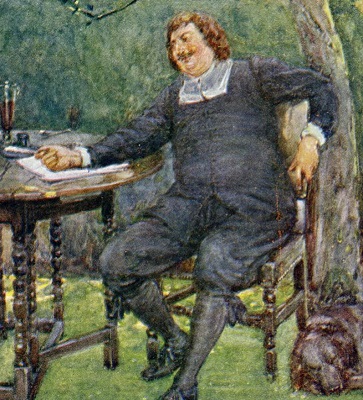
We present this work in honor of the poet’s 400th birthday.
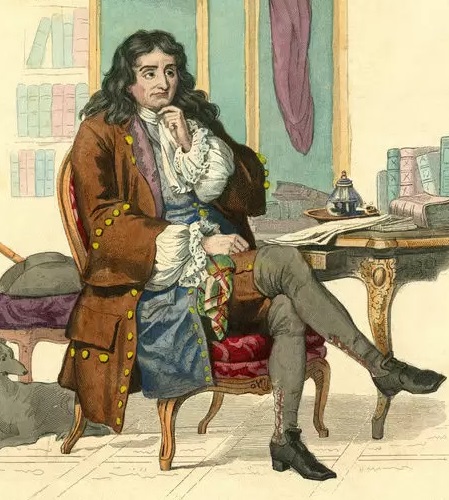
Jean de la Fontaine French 1621 – 1695
Two lawyers to their cause so well adhered, A country justice quite confused appeared, By them the facts were rendered so obscure With which the truth remained he was not sure. At length, completely tired, two straws he sought Of diff’rent lengths, and to the parties brought. These in his hand he held:—the plaintiff drew (So fate decreed) the shortest of the two. On this the other homeward took his way, To boast how nicely he had gained the day.
The bench complained: the magistrate replied Don’t blame I pray—’tis nothing new I’ve tried; Courts often judge at hazard in the law, Without deciding by the longest straw.
Man resorts to the urban mode of living to enjoy commerce and industry, and all the other techniques his system of living can accommodate, and also to gain mutual aid, and in view of religious or secular advantages. In general, all of this can only be achieved by the gathering of many people likely to furnish the markets, each trade, art, technique, or activity lending one or more specialists. Now, these conditions are not present inside a single family, or even inside a single tribe. They result from the variety of the mix and the size of the mass. This is so for two reasons. First, because such is the opinion of the collectivity that takes on those needs. And then, because natural law does not want a small group to keep the exclusivity of knowledge, or have sole use and possession of religious or secular advantages, or free itself from other creaturely characteristics so as to constitute an order proper and useful to itself, by excluding any consideration of the others. To the contrary, in His solicitude and wisdom, God has widely distributed qualifications and advantages among the humans. Thus it is that one finds a savant among such and such a group, a poet among another, in yet another an artisan or a merchant, in such manner that mutual aid can be complete and that everyone can participate in God’s beneficence by taking on a specific task.
Inside the city walls of stone in the pleasure quarter I feel deeply mortified that my talents outshine all the others The river glitters, the waters clear, and the seagulls swim in pairs The sky looks hollow, the clouds serene, and the wild geese fly in rows My embroidered dress partly borrows the hue of hibiscus The emerald wine shares the scent of lotus If I did not reciprocate your feelings Would I dare to feast with you, Master He?
If love is chaste, what bears adultery?
If love is good, and does no evil own,
How can its fire so many flames propone?
If love is joy, why’s it called cruelty?
Who love adores, sails on a lustful sea,
And lets himself into death’s net be sewn,
Which does not tear; he lives for sin alone,
Is stripped of virtue, worships vanity.
For life eternal totally he dies,
And sees his grief but when his grave he spies.
Whoever has been found in loving’s fit,
Let him hate love and flee it in all haste.
Does love taste sweet? Let him despise its taste.
Is love his bread? Let him feed dogs with it.







 Poets Corner