To say you are lovely is to say no more, Than what ten thousand must have said before; To say that beauty and her handmaid grace, Attend your footsteps and illume your face, Is truth, dear maid! in the most literal sense, Your form possessing every excellence: Yet face and shape may be pourtray’d by art; But who can paint the beauties of your heart, The glow of tenderness and filial joy, That only fervent bliss without alloy, Which sweetly mantles on your virgin cheek, Whene’er your honour’d father’s name you speak?— Thus, heavenly maid! the reason is reveal’d Why every artist in your likeness fail’d; Their earthy pencils could not draw the line Between mere beauty and the rays divine, That prove your form all lovely and refin’d, The casket only of a lovelier mind.
When your kiss hovers on my lips, And each of my nerves trembles, When your cheek lies hot on my cheek, And your breast clings to mine, Ha! who can say then exactly what I feel, And maybe this is a deep sin, My fearful soul calls often with a shudder, And yet with passionate lingering My mouth stays glowing at your lips, Hotter grows my cheek, instead of fleeing I press you drunkenly more firmly to my breast, Oh what holds me more strongly—Do you know, by best one?
We present this work in honor of the 230th anniversary of the poet’s death.
Anna Louisa Karsch German 1722 – 1791
My young days were oppressed with cares, On summer mornings I sat there, Sighing my poor stammered song. Not for a young man was my melody, No! for God who the crowds of men does see As if they were an anthill’s throng. Without emotions, as I’ve often said, Without affection, I was wed, Became a mother, as in times of war A young girl would not trust love’s bliss,
On whom a soldier forced his kiss, Whose army reigned as conqueror.
We present this work in honor of the 230th anniversary of the poet’s death.
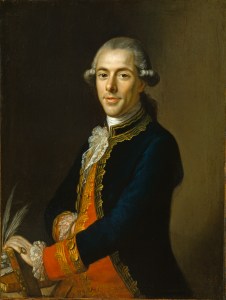
Tomas de Iriarte y Oropesa Spanish 1750 – 1791
The fable which I now present, Occurred to me by accident: And whether bad or excellent, Is merely so by accident.
A stupid ass this morning went Into a field by accident: And cropped his food, and was content, Until he spied by accident A flute, which some oblivious gent Had left behind by accident; When, sniffling it with eager scent, He breathed on it by accident, And made the hollow instrument Emit a sound by accident. “Hurrah, hurrah!” exclaimed the brute, “How cleverly I play the flute!”
A fool, in spite of nature’s bent, May shine for once, by accident.



 Poets Corner