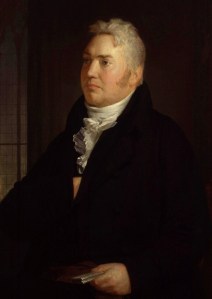
Kubla Khan

Samuel Taylor Coleridge
English
1772 – 1834


In Xanadu did Kubla Khan
A stately pleasure-dome decree:
Where Alph, the sacred river, ran
Through caverns measureless to man
Down to a sunless sea.
So twice five miles of fertile ground
With walls and towers were girdled round:
And there were gardens bright with sinuous rills,
Where blossomed many an incense-bearing tree;
And here were forests ancient as the hills,
Enfolding sunny spots of greenery.

But oh! that deep romantic chasm which slanted
Down the green hill athwart a cedarn cover!
A savage place! as holy and enchanted
As e’er beneath a waning moon was haunted
By woman wailing for her demon-lover!
And from this chasm, with ceaseless turmoil seething,
As if this earth in fast thick pants were breathing,
A mighty fountain momently was forced:
Amid whose swift half-intermitted burst
Huge fragments vaulted like rebounding hail,
Or chaffy grain beneath the thresher’s flail:
And ‘mid these dancing rocks at once and ever
It flung up momently the sacred river.
Five miles meandering with a mazy motion
Through wood and dale the sacred river ran,
Then reached the caverns measureless to man,
And sank in tumult to a lifeless ocean:
And ‘mid this tumult Kubla heard from far
Ancestral voices prophesying war!
The shadow of the dome of pleasure
Floated midway on the waves;
Where was heard the mingled measure
From the fountain and the caves.
It was a miracle of rare device,
A sunny pleasure-dome with caves of ice!

A damsel with a dulcimer
In a vision once I saw:
It was an Abyssinian maid,
And on her dulcimer she played,
Singing of Mount Abora.
Could I revive within me
Her symphony and song,
To such a deep delight ‘twould win me,
That with music loud and long,
I would build that dome in air,
That sunny dome! those caves of ice!
And all who heard should see them there,
And all should cry, Beware! Beware!
His flashing eyes, his floating hair!
Weave a circle round him thrice,
And close your eyes with holy dread,
For he on honey-dew hath fed,
And drunk the milk of Paradise.

Let Us Bestow Joy

In honor of the Turkish holiday, Republic Day, we present this work by one of Turkey’s most celebrated poets.

Nedim
Turkish
1681 – 1730


Let us bestow joy upon this heart filled with woe;
let us go to Sa’dabad, my beloved cypress;
here is the six-oared boat awaiting us;
let us go to Sa’dabad, my beloved cypress.

Let us laugh and play, let us enjoy the world;
let us drink nectar from the newly-made fountain;
let us watch the elixir pour from the dragon’s mouth;
let us go to Sa’dabad, my beloved cypress.

Let us go, for a while, and wander around the pond;
let us later gaze upon the Heavenly Pavilion;
let us always sing songs and recite poems;
let us go to Sa’dabad, my beloved cypress.

Ask your mother’s permission to go to the Friday prayer;
let us steal a day from reproachful destiny;
going through the secret roads towards the quay,
let us go to Sa’dabad, my beloved cypress.

Just you and me and a nice, old musician and,
if you permit, the mad poet Nedim,
let us, today, forget about the others;
let us go to Sa’dabad, my beloved cypress.

Proclamation

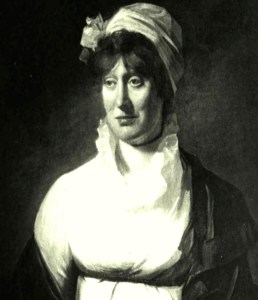
Alison Cockburn
Scots
1712 – 1794


Have you any laws to mend,
Or have you any grievance?
I’m a hero to my trade,
And truly a most leal prince
Would you have war, would you have peace?
Would you be free from taxes?
Come chapping to my father’s door,
You need not doubt of access.

Religion, law, and liberty,
Ye ken are bonnie words, sirs;
They shall be all made sure to you
If ye’ll fight wi’your swords, sirs.
The nation’s debt we soon shall pay,
If you’ll support our right, boys;
No sooner we are brought in play,
Than all things shall be tight, boys.

Ye ken that by a Union law,
Your ancient knigdom’s undone;
That all your ladies, lords, and lairds,
Gang up and live in London.
Nae longer that we will allow,
For crack—it goes asunder,
What took sic time and pains to do,
And let the world wonder

And for your mair encouragement,
Ye shall be pardoned byganes:
Nor mair fight on the Continent,
And leave behind your dry banes.
Then come away, and dinna stay,—
What gars ye look sae loundert?
I’d have ye run, and not delay,
To join my father’s standard.

An Ode on Aeolus’s Harp

We present this work in honor of the poet’s 320th birthday.

James Thomson
Scots
1700 – 1748


I

Ethereal race, inhabitants of air,
Who hymn your God amid the secret grove,
Ye unseen beings, to my harp repair,
And raise majestic strains, or melt in love.

II

Those tender notes, how kindly they upbraid!
With what soft woe they thrill the lover’s heart!
Sure from the hand of some unhappy maid
Who died of love these sweet complainings part.

III

But hark! that strain was of a graver tone,
On the deep strings his hand some hermit throws;
Or he, the sacred Bard, who sat alone
In the drear waste and wept his people’s woes.

IV

Such was the song which Zion’s children sung
When by Euphrates’ stream they made their plaint;
And to such sadly solemn notes are strung
Angelic harps to soothe a dying saint.

V

Methinks I hear the full celestial choir
Through Heaven’s high dome their awful anthem raise;
Now chanting clear, and now they all conspire
To swell the lofty hymn from praise to praise.

VI

Let me, ye wandering spirits of the wind,
Who, as wild fancy prompts you, touch the string,
Smit with your theme, be in your chorus joined,
For till you cease my muse forgets to sing.

Ode on Solitude

Alexander Pope
English
1688 – 1744


Happy the man, whose wish and care
A few paternal acres bound,
Content to breathe his native air,
In his own ground.

Whose heards with milk, whose fields with bread,
Whose flocks supply him with attire,
Whose trees in summer yield him shade,
In winter fire.

Blest! who can unconcern’dly find
Hours, days, and years slide soft away,
In health of body, peace of mind,
Quiet by day,

Sound sleep by night; study and ease
Together mix’d; sweet recreation,
And innocence, which most does please,
With meditation.

Thus let me live, unseen, unknown;
Thus unlamented let me dye;
Steal from the world, and not a stone
Tell where I lye.

The Assignation

George Farquhar
Irish
1677 – 1707


The Minute’s past appointed by my Fair,
The Minute’s fled
And leaves me dead
With Anguish and Despair.

My flatter’d Hopes their Flight did make
With the appointed Hour;
None can the Minute’s past o’retake,
And nought my Hopes restore.

Cease your Plaints, and make no Moan,
Thou sad repining Swain;
Although the fleeting Hour be gone,
The Place doe’s still remain.

The Place remains, and she may make
Amends for all your Pain;
Her Presence can past Time o’ertake,
Her Love your Hopes regain.

from Rādhikā-sāntvanam

Muddupalani
Indian
c. 1739 – 1790


If I ask her not to kiss me,
stroking on my cheeks
she presses my lips hard against hers.

If I ask her not to touch me,
stabbing me with her firm breasts
she hugs me.

If I ask her not to get too close
for it is not decorous,
she swears at me loudly.

If I tell her of my vow not
to have a woman in my bed,
she hops on
and begins the game of love.

Appreciative,
she lets me drink from her lips,
fondles me, talks on,
making love again and again.

How could I stay away
from her company?

From the Seashore

In honor of the Russian holiday, National Day, we present this work by the nation’s first female professional poet.

Anna Bunina
Russian
1774 – 1829


The shining sea
Seamless from the sky,
The quiet waves
Splashed upon the shore,
The gentle swells
Shivered just a little.

The sun is extinguished,
There is no moon,
Scarlet blaze
Glints in the west,
Birds in their nests,
Flocks in their roosts.

Everything suddenly shushed,
Everything in its place.

The room is still,
There is no rustling.
The children are cuddled
Modestly in the corners.

Lina touched
The harp strings:
The golden harp
Raised its voice;
Sounds in harmony
Sing with Lina.

Rosy flames
Shine from the fireplace;
The clear bright fire
Skips upon the coals;
The dark-gray smoke
Twists in a column.

The fierce flame
Scorches the soul;
The heart languishes,
Everything is desiccated.
Poison flows
In my veins.

Tears ran dry
In cloudy eyes,
Sighs stopped
The breast from heaving,
Speech freezes
On chilled lips!

Sea rise up!
Be a coffin for me!
Golden harp,
Strike like thunder!
Flame overflow,
Incinerate this poor woman!

The Six Bards

James MacPherson
Scots
1736 – 1796


Night is dull and dark,
The clouds rest on the hills;
No star with twinkling beam,
No moon looks from the skies.
I hear the blast in the wood,
But distant and dull I hear it.
The stream of the valley murmurs,
Low is its murmur too.
From the tree at the grave of the dead,
The lonely screech-owl groans.
I see a dim form on the plain,
‘Tis a ghost! it fades, it flies;
Some dead shall pass this way.
From the lowly hut of the hill
The distant dog is howling;
The stag lies by the mountain-well,
The hind is at his side;
She hears the wind in his horns,
She starts, but lies again.
The roe is in the cleft of the rock:
The heath-cock’s head beneath his wing.
No beast, no bird is abroad,
But the owl, and the howling fox;
She on the leafless tree,
He on the cloudy hill.
Dark, panting, trembling, sad,
The traveller has lost his way;
Through shrubs, through thorns he goes,
Beside the gurgling rills;
He fears the rock and the pool,
He fears the ghost of the night.
The old tree groans to the blast;
The falling branch resounds.
The wind drives the clung thorn
Along the sighing grass;
He shakes amid the night.
Dark, dusty, howling, is night,
Cloudy, windy, and full of ghosts;
The dead are abroad; my friends
Receive me from the night.

Hokku Poems in Four Seasons

We present this work in honor of Greenery Day.

Yosa Buson
Japanese
1716 – 1784


Spring

The year’s first poem done,
with smug self confidence
a haikai poet.

Longer has become the daytime;
a pheasant is fluttering
down onto the bridge.

Yearning for the Bygones

Lengthening days,
accumulating, and recalling
the days of distant past.

Slowly passing days,
with an echo heard here in a
corner of Kyoto.

The white elbow
of a priest, dozing,
in the dusk of spring.

Into a nobleman,
a fox has changed himself
early evening of spring.

The light on a candle stand
is transferred to another candle
spring twilight.

A short nap,
then awakening
this spring day has darkened.

Who is it for,
this pillow on the floor,
in the twilight of spring?

The big gateway’s heavy doors,
standing in the dusk of spring.

Hazy moonlight —
someone is standing
among the pear trees.

Blossoms on the pear tree,
lighten by the moonlight, and there
a woman is reading a letter.

Springtime rain — almost dark,
and yet today still lingers.

Springtime rain —
a little shell on a small beach,
enough to moisten it.

Springtime rain is falling,
as a child’s rag ball is soaking
wet on the house roof.

Summer

Within the quietness
of a lull in visitors’ absence,
appears the peony flower!

Peony having scattered, two
or three petals lie on one another.

The rain of May —
facing toward the big river, houses,
just two of them.

At a Place Called Kaya in Tanba

A summer river being crossed,
how pleasing,
with sandals in my hands!

The mountain stonecutter’s chisel;
being cooled in the clear water.

Grasses wet in the rain,
just after the festival cart passed by.

To my eyes how delightful
the fan of my beloved is,
in complete white.

A flying cuckoo,
over the Heian capital,
goes diagonally across the city.

Evening breeze —
water is slapping against
the legs of a blue heron.

An old well —
jumping at a mosquito,
the fish’s sound is dark.

Young bamboo trees —
at Hashimoto, the courtesan,
is she still there or not?

After having been fallen,
its image still stands —
the peony flower.

Stepping on the Eastern Slope

Wild roses in bloom —
so like a pathway in,
or toward, my home village.

With sorrow while coming upon the hill
—flowering wild roses.

Summer night ending so soon,
with on the river shallows still remains
the moon in a sliver.

Autumn

It penetrates into me;
stepping on the comb of my gone wife,
in the bedroom.

More than last year,
I now feel solitude;
this autumn twilight.

This being alone may even be a kind of happy
— in the autumn dusk.

Moon in the sky’s top,
clearly passes through this
poor town street.

This feeling of sadness —
a fishing string being blown by the autumn wind.

Winter

Let myself go to bed;
New Year’s Day is only a matter
for tomorrow.

Camphor tree roots are quietly getting wet,
in the winter rainy air.

A handsaw is sounding,
as if from a poor one,
at midnight in this winter.

Old man’s love affair;
in trying to forget it,
a winter rainfall.

In an old pond,
a straw sandal is sinking
— it is sleeting.