She walks in beauty, like the night Of cloudless climes and starry skies; And all that’s best of dark and bright Meet in her aspect and her eyes; Thus mellowed to that tender light Which heaven to gaudy day denies.
One shade the more, one ray the less, Had half impaired the nameless grace Which waves in every raven tress, Or softly lightens o’er her face; Where thoughts serenely sweet express, How pure, how dear their dwelling-place.
And on that cheek, and o’er that brow, So soft, so calm, yet eloquent, The smiles that win, the tints that glow, But tell of days in goodness spent, A mind at peace with all below, A heart whose love is innocent!
We present this work in honor of the 105th anniversary of the poet’s death.
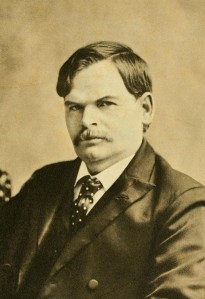
William Wilfrid Campbell Canadian 1858 – 1918
Out in a world of death far to the northward lying, Under the sun and the moon, under the dusk and the day; Under the glimmer of stars and the purple of sunsets dying, Wan and waste and white, stretch the great lakes away.
Never a bud of spring, never a laugh of summer, Never a dream of love, never a song of bird; But only the silence and white, the shores that grow chiller and dumber, Wherever the ice winds sob, and the griefs of winter are heard.
Crags that are black and wet out of the grey lake looming, Under the sunset’s flush and the pallid, faint glimmer of dawn; Shadowy, ghost-like shores, where midnight surfs are booming Thunders of wintry woe over the spaces wan.
Lands that loom like spectres, whited regions of winter, Wastes of desolate woods, deserts of water and shore; A world of winter and death, within these regions who enter, Lost to summer and life, go to return no more.
Moons that glimmer above, waters that lie white under, Miles and miles of lake far out under the night; Foaming crests of waves, surfs that shoreward thunder, Shadowy shapes that flee, haunting the spaces white.
Lonely hidden bays, moon-lit, ice-rimmed, winding, Fringed by forests and crags, haunted by shadowy shores; Hushed from the outward strife, where the mighty surf is grinding Death and hate on the rocks, as sandward and landward it roars.
I came to your town, my love, And you were away, away! I said “She is with the Queen’s maidens: They tarry long at their play. They are stringing her words like pearls To throw to the dukes and earls.” But O, the pity! I had but a morn of windy red To come to the town where you were bred, And you were away, away!
I came to your town, my love, And you were away, away! I said, “She is with the mountain elves And misty and fair as they. They are spinning a diamond net To cover her curls of jet.” But O, the pity! I had but a noon of searing heat To come to your town, my love, my sweet, And you were away, away!
I came to your town, my love, And you were away, away! I said, “She is with the pale white saints, And they tarry long to pray. They give her a white lily-crown, And I fear she will never come down.” But O, the pity! I had but an even grey and wan To come to your town and plead as man, And you were away, away!
I heard the bells on Christmas Day Their old, familiar carols play, and mild and sweet The words repeat Of peace on earth, good-will to men!
And thought how, as the day had come, The belfries of all Christendom Had rolled along The unbroken song Of peace on earth, good-will to men!
Till ringing, singing on its way, The world revolved from night to day, A voice, a chime, A chant sublime Of peace on earth, good-will to men!
Then from each black, accursed mouth The cannon thundered in the South, And with the sound The carols drowned Of peace on earth, good-will to men!
It was as if an earthquake rent The hearth-stones of a continent, And made forlorn The households born Of peace on earth, good-will to men!
And in despair I bowed my head; “There is no peace on earth,” I said; “For hate is strong, And mocks the song Of peace on earth, good-will to men!”
Then pealed the bells more loud and deep: “God is not dead, nor doth He sleep; The Wrong shall fail, The Right prevail, With peace on earth, good-will to men.”
We present this work in honor of the 75th anniversary of the poet’s death.
Duncan Campbell Scott Canadian 1862 – 1947
A deep bell that links the downs To the drowsy air; Every loop of sound that swoons, Finds a circle fair, Whereon it doth rest and fade; Every stroke that dins is laid Like a node, Spinning out the quivering, fine, Vibrant tendrils of a vine: (Bim – bim – bim.) How they wreathe and run, Silvern as a filmy light, Filtered from the sun: The god of sound is out of sight, And the bell is like a cloud, Humming to the outer rim, Low and loud: (Bim – bim – bim.) Throwing down the tempered lull, Fragile, beautiful: Married drones and overtones, How we fancy them to swim, Spreading into shapes that shine, With the aura of the metals, Prisoned in the bell, Fulvous tinted as a shell, Dreamy, dim, Deep in amber hyaline: (Bim – bim – bim.)
We present this work in honor of the 145th anniversary of the poet’s death.
James Ballantine Scots 1806 – 1877
Stout Laird o’ Blackford Hill, let me But gain your honour’s lug a wee, I fain wad let your lairdship see Sufficient cause To mak your hill to a’ as free As ance it was.
Weel mind I o’ the joyous days I gathered hips, an’ haws, an’ slaes, Climbing ower Blackford’s heathy braes Birds’ nests to herry, Or smearing face, an’ hands, an’ claes, Wi’ bramble berry …
Then shall a laird whase kindly heart Has ever ta’en the puir man’s part, Be reckon’d like some mean upstart, O’ saulless stature, Wha sells, as at an auction mart, The face o’ nature?
Though bairns may pu’, when yap or drouthy, A neep or bean, to taste their mouthy, Losh, man! their hames are no sae couthy As your bien Ha’; Though puir folks’ bairns are unco toothie, Their feeding’s sma’.
An’ a’ the neeps, an’ a’ the beans, The hips, the haws, the slaes, the geens, That e’er were pu’ed by hungry weans, Could ne’er be missed By lairds like you, wi’ ample means In bank and kist.
Then listen to my earnest prayer, An’ open Blackford Hill ance mair; Let us a’ pree the caller air That sweeps its braes, An’ mak it worth the poet’s care To sing your praise.
We present this work in honor of the poet’s 215th birthday.
John Greenleaf Whittier American 1807 – 1892
He comes, – he comes, – the Frost Spirit comes! You may trace his footsteps now On the naked woods and the blasted fields And the brown hill’s withered brow. He has smitten the leaves of the gray old trees Where their pleasant green came forth, And the winds, which follow wherever he goes, Have shaken them down to earth.
He comes, – he comes, – the Frost Spirit comes! From the frozen Labrador, From the icy bridge of the northern seas, Which the white bear wanders o’er, Where the fisherman’s sail is stiff with ice, And the luckless forms below In the sunless cold of the lingering night Into marble statues grow!
He comes, – he comes, – the Frost Spirit comes! On the rushing Northern blast, And the dark Norwegian pines have bowed As his fearful breath went past. With an unscorched wing he has hurried on, Where the fires of Hecla glow On the darkly beautiful sky above And the ancient ice below.
He comes, – he comes, – the Frost Spirit comes! And the quiet lake shall feel The torpid touch of his glazing breath, And ring to the skater’s heel; And the streams which danced on the broken rocks, Or sang to the leaning grass, Shall bow again to their winter chain, And in mournful silence pass.
He comes, – he comes, – the Frost Spirit comes! Let us meet him as we may, And turn with the light of the parlor–fire His evil power away; And gather closer the circle ‘round, When the firelight dances high, And laugh at the shriek of the baffled Fiend As his sounding wing goes by!




 Poets Corner