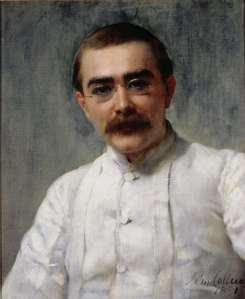
The Law of the Jungle

Rudyard Kipling
English
1865 – 1936


Now this is the Law of the Jungle — as old and as true as the sky;
And the Wolf that shall keep it may prosper, but the Wolf that shall break it must die.

As the creeper that girdles the tree-trunk the Law runneth forward and back —
For the strength of the Pack is the Wolf, and the strength of the Wolf is the Pack.

Wash daily from nose-tip to tail-tip; drink deeply, but never too deep;
And remember the night is for hunting, and forget not the day is for sleep.

The Jackal may follow the Tiger, but, Cub, when thy whiskers are grown,
Remember the Wolf is a Hunter — go forth and get food of thine own.

Keep peace withe Lords of the Jungle — the Tiger, the Panther, and Bear.
And trouble not Hathi the Silent, and mock not the Boar in his lair.

When Pack meets with Pack in the Jungle, and neither will go from the trail,
Lie down till the leaders have spoken — it may be fair words shall prevail.

When ye fight with a Wolf of the Pack, ye must fight him alone and afar,
Lest others take part in the quarrel, and the Pack be diminished by war.

The Lair of the Wolf is his refuge, and where he has made him his home,
Not even the Head Wolf may enter, not even the Council may come.

The Lair of the Wolf is his refuge, but where he has digged it too plain,
The Council shall send him a message, and so he shall change it again.

If ye kill before midnight, be silent, and wake not the woods with your bay,
Lest ye frighten the deer from the crop, and your brothers go empty away.

Ye may kill for yourselves, and your mates, and your cubs as they need, and ye can;
But kill not for pleasure of killing, and seven times never kill Man!

If ye plunder his Kill from a weaker, devour not all in thy pride;
Pack-Right is the right of the meanest; so leave him the head and the hide.

The Kill of the Pack is the meat of the Pack. Ye must eat where it lies;
And no one may carry away of that meat to his lair, or he dies.

The Kill of the Wolf is the meat of the Wolf. He may do what he will;
But, till he has given permission, the Pack may not eat of that Kill.

Cub-Right is the right of the Yearling. From all of his Pack he may claim
Full-gorge when the killer has eaten; and none may refuse him the same.

Lair-Right is the right of the Mother. From all of her year she may claim
One haunch of each kill for her litter, and none may deny her the same.

Cave-Right is the right of the Father — to hunt by himself for his own:
He is freed of all calls to the Pack; he is judged by the Council alone.

Because of his age and his cunning, because of his gripe and his paw,
In all that the Law leaveth open, the word of your Head Wolf is Law.

Now these are the Laws of the Jungle, and many and mighty are they;
But the head and the hoof of the Law and the haunch and the hump is — Obey!

The Eternal Song

Rosemonde Gérard
French
1871 – 1953


When you are old and I am old,
When my blond hair will be white hair,
In the brightening sun of the May garden,
We’ll go and warm our old trembling limbs.
As renewal sets our hearts in joy,
We will still believe to be young lovers,
And I’ll smile at you while shaking my head,
And we’ll be an adorable old couple.
We’ll look at each other, sitting under our vine,
With small eyes, tender and bright,
When you are old and I am old,
When my blond hair will be white hair.

On our friendly bench, all greenish with moss,
On the bench of old, we’ll talk again,
We will have a tender and very sweet joy,
Each sentence always ending in a kiss.
How many times may I have said “I love you”?
Then with great care we will recount them.
We will remember a thousand things, even
Exquisite little nothings we will ramble on.
A ray will descend, with a soft caress,
Among our white hair, all pink, to rest,
When on our old bench all greenish with moss,
On the bench of old, we’ll talk again.

And as every day I love you more,
Today more than yesterday and much less than tomorrow,
What will facial wrinkles matter then?
My love will be more thoughtful—and serene.
Considering that everyday memories are piling up,
These memories of mine will be yours too.
Those common memories entwine us all the more
And constantly between us weave other links.
It’s true, we’ll be old, very old, weakened by age,
But stronger each day I will squeeze your hand
For you see, every day I love you more,
Today more than yesterday and much less than tomorrow.

And of this dear love that passes like a dream,
I want to keep everything at the bottom of my heart,
To remember if I can the too short impression
To slowly savour it again later.
I bury everything that comes from it like a miser,
Hoarding with ardour for my old age;
I will be rich then of a rare wealth
For I’ll have kept all the gold of my young love!
So from this ending past of happiness,
My memory will sometimes bring back the sweetness;
And all this dear love that passes like a dream
I will have it preserved at the bottom of my heart.

When you are old and I am old,
When my blond hair will be white hair,
In the brightening sun of the May garden,
We’ll go and warm our old trembling limbs.
As renewal sets our hearts in joy,
We will still believe in the happy days of yesteryear,
And I’ll smile at you while shaking my head
And you will quaver love words to me.
We’ll look at each other, sitting under our vine,
With small eyes, tender and bright,
When you are old and I am old,
When my blond hair will be white hair.

To the Bio-Bio

In honor of Chilean Independence Day, we present this work by one of Chile’s greatest poets.

Andres Bello
Chilean
1781 – 1865


Blest were he, O Bio-Bio!
Who could dwell forevermore
In a deep grove, cool and shady,
Upon thine enchanted shore!

Just a lowly thatched-roofed cottage
Where thy limpid waters are seen
Pouring their calm flood in silence
Amid foliage fresh and green;

Where, instead of shifting changes
In the fickle things of state,
Wind-stirred oaks and maitens murmur,
And the forest peace is great;

Where the bird amid the branches,
In the early dawning gray,
Sings its untaught, artless music,
Greeting thus the new-born day.

In that humble thatched-roof cottage,
Oh, how happy were my lot,
In the peace that nothing troubles,
Envied not and envying not!

This to me in truth were sweeter
Than the Babel wild and loud
Where in chase of a chimera
All are rushing in a crowd;

Where dark treachery and falsehood
Near the quaking altar stay
That the people’s favor raises
To the idols of a day.

Sweet repose, most blissful quiet,
Earthly paradise divine!
Has the palm of war or wisdom
Worth which can outrival thine?

Truth I love, not adulation—
Truth all unadorned and plain,
Not the clamorous applauses
That are raised in Fortune’s train.

Growing old, for that false treasure
I would cease my soul to fret—
Say ‘Farewell to disappointments!
The forgetful I forget.

‘Others call excitement pleasure,
Madly seeking fame or pelf;
I in earth’s most hidden corner
Wish to live now for myself.’

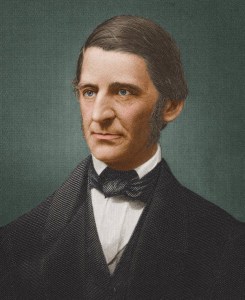
Concord Hymn

We present this work in honor of Constitution Day.

Ralph Waldo Emerson
American
1803 – 1882


By the rude bridge that arched the flood,
Their flag to April’s breeze unfurled,
Here once the embattled farmers stood
And fired the shot heard round the world.

The foe long since in silence slept;
Alike the conqueror silent sleeps;
And Time the ruined bridge has swept
Down the dark stream which seaward creeps.

On this green bank, by this soft stream,
We set today a votive stone;
That memory may their deed redeem,
When, like our sires, our sons are gone.

Spirit, that made those heroes dare
To die, and leave their children free,
Bid Time and Nature gently spare
The shaft we raise to them and thee.

The End of the Furrow

William Wilfrid Campbell
Canadian
1858 – 1918


When we come to the end of the furrow,
When our last day’s work is done,
We will drink of the long red shaft of light
That slants from the westering sun.

We will turn from the field of our labour,
From the warm earth glad and brown,
And wend our feet up that village street,
And with our folk lie down.

Yea, after the long toil, surcease,
Rest to the hearts that roam,
When we join in the mystic silence of eve
The glad procession home.

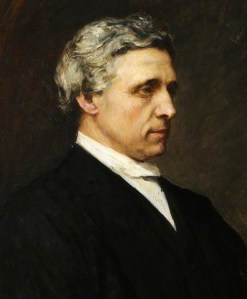
You Are Old, Father William

We present this work in honor of National Senior Citizens’ Day.

Lewis Carroll
English
1832 – 1898


“You are old, Father William,” the young man said,
“And your hair has become very white;
And yet you incessantly stand on your head—
Do you think, at your age, it is right?”

“In my youth,” Father William replied to his son,
“I feared it might injure the brain;
But now that I’m perfectly sure I have none,
Why, I do it again and again.”

“You are old,” said the youth, “As I mentioned before,
And have grown most uncommonly fat;
Yet you turned a back-somersault in at the door—
Pray, what is the reason of that?”

“In my youth,” said the sage, as he shook his grey locks,
“I kept all my limbs very supple
By the use of this ointment—one shilling a box—
Allow me to sell you a couple?”

“You are old,” said the youth, “And your jaws are too weak
For anything tougher than suet;
Yet you finished the goose, with the bones and the beak—
Pray, how did you manage to do it?”

“In my youth,” said his father, “I took to the law,
And argued each case with my wife;
And the muscular strength which it gave to my jaw,
Has lasted the rest of my life.”

“You are old,” said the youth, “one would hardly suppose
That your eye was as steady as ever;
Yet you balanced an eel on the end of your nose—
What made you so awfully clever?”

“I have answered three questions, and that is enough,”
Said his father; “don’t give yourself airs!
Do you think I can listen all day to such stuff?
Be off, or I’ll kick you down stairs!”

Be Drunk

Charles Baudelaire
French
1821 – 1867


Always be drunk.
That’s it!
The great imperative!
In order not to feel
Time’s horrid fardel
bruise your shoulders,
grinding you into the earth,
Get drunk and stay that way.
On what?
On wine, poetry, virtue, whatever.
But get drunk.
And if you sometimes happen to wake up
on the porches of a palace,
in the green grass of a ditch,
in the dismal loneliness of your own room,
your drunkenness gone or disappearing,
ask the wind,
the wave,
the star,
the bird,
the clock,
ask everything that flees,
everything that groans
or rolls
or sings,
everything that speaks,
ask what time it is;
and the wind,
the wave,
the star,
the bird,
the clock
will answer you:
“Time to get drunk!
Don’t be martyred slaves of Time,
Get drunk!
Stay drunk!
On wine, virtue, poetry, whatever!”

The Tide Rises, the Tide Falls

We present this work in honor of National Coast Guard Day.

Henry Wadsworth Longfellow
American
1807 – 1882


The tide rises, the tide falls,
The twilight darkens, the curlew calls;
Along the sea-sands damp and brown
The traveler hastens toward the town,
And the tide rises, the tide falls.
Darkness settles on roofs and walls,
But the sea, the sea in darkness calls;
The little waves, with their soft, white hands
Efface the footprints in the sands,
And the tide rises, the tide falls.
The morning breaks; the steeds in their stalls
Stamp and neigh, as the hostler calls;
The day returns, but nevermore
Returns the traveler to the shore.
And the tide rises, the tide falls.

Shiloh: A Requiem

We present this work in honor of the poet’s 200th birthday.

Herman Melville
American
1819 – 1891


Skimming lightly, wheeling still,
The swallows fly low
Over the field in clouded days,
The forest-field of Shiloh—
Over the field where April rain
Solaced the parched ones stretched in pain
Through the pause of night
That followed the Sunday fight
Around the church of Shiloh—
The church so lone, the log-built one,
That echoed to many a parting groan
And natural prayer
Of dying foemen mingled there—
Foemen at morn, but friends at eve—
Fame or country least their care:
(What like a bullet can undeceive!)
But now they lie low,
While over them the swallows skim,
And all is hushed at Shiloh.