I have a white rose to tend
In July as in January;
I give it to the true friend
Who offers his frank hand to me.
And for the cruel one whose blows
Break the heart by which I live,
Thistle nor thorn do I give:
For him, too, I have a white rose.
When the grey lake-water rushes
Past the dripping alder-bushes,
And the bodeful autumn wind
In the fir-tree weeps and hushes, —
When the air is sharply damp
Round the solitary camp,
And the moose-bush in the thicket
Glimmers like a scarlet lamp, —
When the birches twinkle yellow,
And the cornel bunches mellow,
And the owl across the twilight
Trumpets to his downy fellow, —
When the nut-fed chipmunks romp
Through the maples’ crimson pomp,
And the slim viburnum flushes
In the darkness of the swamp, —
When the blueberries are dead,
When the rowan clusters red,
And the shy bear, summer-sleekened,
In the bracken makes his bed, —
On a day there comes once more
To the latched and lonely door,
Down the wood-road striding silent,
One who has been here before.
Green spruce branches for his head,
Here he makes his simple bed,
Crouching with the sun, and rising
When the dawn is frosty red.
All day long he wanders wide
With the grey moss for his guide,
And his lonely axe-stroke startles
The expectant forest-side.
Toward the quiet close of day
Back to camp he takes his way,
And about his sober footsteps
Unafraid the squirrels play.
On his roof the red leaf falls,
At his door the bluejay calls,
And he hears the wood-mice hurry
Up and down his rough log walls;
Hears the laughter of the loon
Thrill the dying afternoon;
Hears the calling of the moose
Echo to the early moon.
And he hears the partridge drumming,
The belated hornet humming, —
All the faint, prophetic sounds
That foretell the winter’s coming.
And the wind about his eaves
Through the chilly night-wet grieves,
And the earth’s dumb patience fills him,
Fellow to the falling leaves.
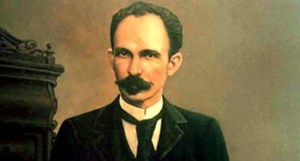
We present this work in honor of the poet’s 205th birthday.
José Jacinto Milanés Cuban 1814 – 1863
I can but pity him, the one
Who lingers in dull Slumber’s thralls,
While on his roof, unnoticed, fall
The effulgence of the rising sun.
Is there a purer, rarer treat
Than to leap off the wrinkled bed,
And, in the country, lightly tread
Of dewy grass the carpet neat?
I say the country, for I ween
Sweet Morning loses half her smile
Without there be soft winds the while,
And much of blue, and much of green.
These are not had in town, where gray,
And cold and damp, the misty gloom,
As in a suffocating tomb,
Shuts out the morning smile of day.
And then, those rows of houses tall,
With their grim faces, rigid, even,
Weary the soul: the light of heaven
By fragments seems on them to fall.
No! I must stray with footsteps free,
In some delightful rustic place
Without a blur the virgin face
Of life-restoring Morn to see.
To see her in her robe of light,
Far in the crimson Orient shine, —
Like a pure maid, whose smile divine
Elates the soul with chaste delight.
Oh! is there one so poor of thought,
And with a heart so dead and cold,
Who can at the break of day behold
Sweet Nature’s charms, and love her not?
See her with life and beauty new
Roll with the ever murm’ring river;
With the lithe branches dance and quiver;
Sparkle in the resplendent dew.
Low in the reptile on the ground;
Erect and nimble in the brute;
Delicious in the hanging fruit;
Smiling in all the flowers around!
Ah me! I do remember well
When but a simple, beardless boy,
How oft, and with what eager joy,
Came I upon such scenes to dwell!
Now would a butterfly’s light wings
Entrance me with their gaudy hues;
Then would I set myself to muse
Upon a rose, — and dream such things!
And always gay! ‘Twas natural:
Care had not yet impress’d its furrow
Upon my brow, nor had of sorrow
Tasted my lips the bitter gall!
Those days of boyhood vanish’d soon;
Anon, I felt Love’s burning sting;
And then I deemed a foolish thing
To doat on hill, and sun, and moon.
Ungrateful that I was! But how
Severely, Nature, did I pay
For my neglect! She who for aye
Had vowed to love, — forgot her vow!
Most bitterly I wept, and yearned
For her dear presence; and my strength
I fear’d me would have failed… At length
Peace to my shatter’d heart returned.
Oh! what an anguish most sublime
‘Tis to forget! But ah! at last
The iron chain that bound me fast
Fell ‘neath the steady strokes of Time.
Time! Who with hand unseen and noiseless
Pours on our raven locks his snow;
Quenches the light in eyes that glow,
And Beauty’s lips makes pale and voiceless!
And now, once more, I love to stroll
And view sweet Nature at this hour;
For, then, her freshness has the pow’r
To soothe the fever of my soul.
But still I feel deep in my breast
The old wounds bleeding, and I sigh
Whene’er I happen to pass by,
Hand clasp’ed in hand, two lovers blest.
And even sometimes, if I hear
The tender whisp’rings, fraught with meaning,
Of two palms to each other leaning,
I feel a loneliness most dreer!…
If, on a bough, I see, alone,
Two birds exchange delightful lays;
If two stars blend their am’rous rays;
If two waves rolling into one;
If two clouds in the heavens glide,
And on their way their shadows mingle;
If two paths, meeting, form a single;
If two hills standing side by side;
I linger; and with gloomy mood
Remember that I’m loved by none;
That while so many a mated one
There be, I weep in solitude!
Another year!—another deadly blow!
Another mighty Empire overthrown!
And We are left, or shall be left, alone;
The last that dare to struggle with the Foe.
‘Tis well! from this day forward we shall know
That in ourselves our safety must be sought;
That by our own right hands it must be wrought;
That we must stand unpropped, or be laid low.
O dastard whom such foretaste doth not cheer!
We shall exult, if they who rule the land
Be men who hold its many blessings dear,
Wise, upright, valiant; not a servile band,
Who are to judge of danger which they fear,
And honour which they do not understand.
Where shall we go for our garlands glad
At the falling of the year,
When the burnt-up banks are yellow and sad,
When the boughs are yellow and sere?
Where are the old ones that once we had,
And when are the new ones near?
What shall we do for our garlands glad
At the falling of the year?
Child! can I tell where the garlands go?
Can I say where the lost leaves veer
On the brown-burnt banks, when the wild winds blow,
When they drift through the dead-wood drear?
Girl! when the garlands of next year glow,
You may gather again, my dear—
But I go where the last year’s lost leaves go
At the falling of the year.
Work! for the night is coming;
Work! through the morning hours;
Work! while the dew is sparkling;
Work! ‘mid the springing flowers;
Work! while the day grows brighter,
Under the glowing sun;
Work! for the night is coming,—
Night, when man’s work is done.
Work! for the night is coming;
Work! through the sunny noon;
Fill the bright hours with labour,
Rest cometh sure and soon.
Give to each flying minute
Something to keep in store;
Work! for the night is coming,—
Night, when man works no more.
Work! for the night is coming;
Under the sunset skies,
While their bright tints are glowing,
Work! for the daylight flies;
Work! till the last beam fadeth,
Fadeth to shine no more;
Work! while the night is darkening,—
Night, when man’s work is o’er.
When yellow-lock’d and crystal ey’d
I dream’d green woods among;
Where tall trees wav’d from side to side,
And in their green breasts deep and wide,
I saw the building blue jay hide,
O, then the earth was young!
The winds were fresh and brave and bold,
The red sun round and strong;
No prophet voice chill, loud and cold,
Across my woodland dreamings roll’d,
‘The green earth waxeth sere and old,
That once was fair and young!’
I saw in scarr’d and knotty bole,
The fresh’ning of the sap;
When timid spring gave first small dole,
Of sunbeams thro’ bare boughs that stole,
I saw the bright’ning blossoms roll,
From summer’s high pil’d lap.
And where an ancient oak tree lay
The forest stream across,
I mus’d above the sweet shrill spray,
I watch’d the speckl’d trout at play,
I saw the shadows dance and sway
On ripple and on moss.
I pull’d the chestnut branches low,
As o’er the stream they hung,
To see their bursting buds of snow—
I heard the sweet spring waters flow—
My heart and I we did not know
But that the earth was young!
I joy’d in solemn woods to see,
Where sudden sunbeams clung,
On open space of mossy lea,
The violet and anemone,
Wave their frail heads and beckon me—
Sure then the earth was young!
I heard the fresh wild breezes birr,
New budded boughs among,
I saw the deeper tinting stir
In the green tassels of the fir,
I heard the pheasant rise and whirr,
Above her callow young.
I saw the tall fresh ferns prest,
By scudding doe and fawn;
I say the grey dove’s swelling breast,
Above the margin of her nest;
When north and south and east and west
Roll’d all the red of dawn.
At eventide at length I lay,
On grassy pillow flung;
I saw the parting bark of day,
With crimson sails and shrouds all gay,
With golden fires drift away,
The billowy clouds among.
I saw the stately planets sail
On that blue ocean wide;
I saw blown by some mystic gale,
Like silver ship in elfin tale,
That bore some damsel rare and pale,
The moon’s slim crescent glide.
And ev’ry throb of spring
The rust’ling boughs among,
That filled the silver vein of brook,
That lit with bloom the mossy nook,
Cried to my boyish bosom: ‘Look!
How fresh the earth and young!’
The winds were fresh, the days as clear
As crystals set in gold.
No shape, with prophet-mantle drear,
Thro’ those old woods came drifting near,
To whisper in my wond’ring ear,
‘The green earth waxeth old.’
We present this work in honor of the Chung Yeung Festival.
Wu Tsao Chinese 1799 – 1862
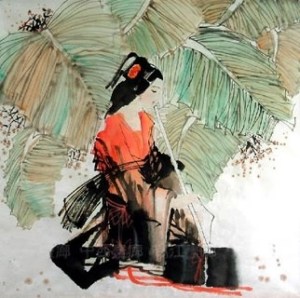
On your slender body
Your jade and coral girdle ornaments chime
Like those of a celestial companion
Come from the Green Jade City of Heaven.
One smile from you when we meet,
And I become speechless and forget every word.
For too long you have gathered flowers,
And leaned against the bamboos,
Your green sleeves growing cold,
In your deserted valley:
I can visualize you all alone,
A girl harboring her cryptic thoughts.
You glow like a perfumed lamp
In the gathering shadows.
We play wine games
And recite each other’s poems.
Then you sing `Remembering South of the River’
With its heart breaking verses. Then
We paint each other’s beautiful eyebrows.
I want to possess you completely –
Your jade body
And your promised heart.
It is Spring.
Vast mists cover the Five Lakes.
My dear, let me buy a red painted boat
And carry you away.

 Poets Corner