We present this work in honor of the poet’s 150th birthday.
John Shaw Neilson
Australian
1872 – 1942
Your voice was the rugged old voice that I knew; I gave the best grip of my greeting to you. I knew not of your lips— you knew not of mine; Of travel and travail we gave not a sign.
We drank and we chorused with quips in our eyes; But under our song was the meeting of sighs. I knew not of your lips— you knew not of mine; For lean years and lone years had watered the wine.
We present this work in honor of the poet’s 115th birthday.
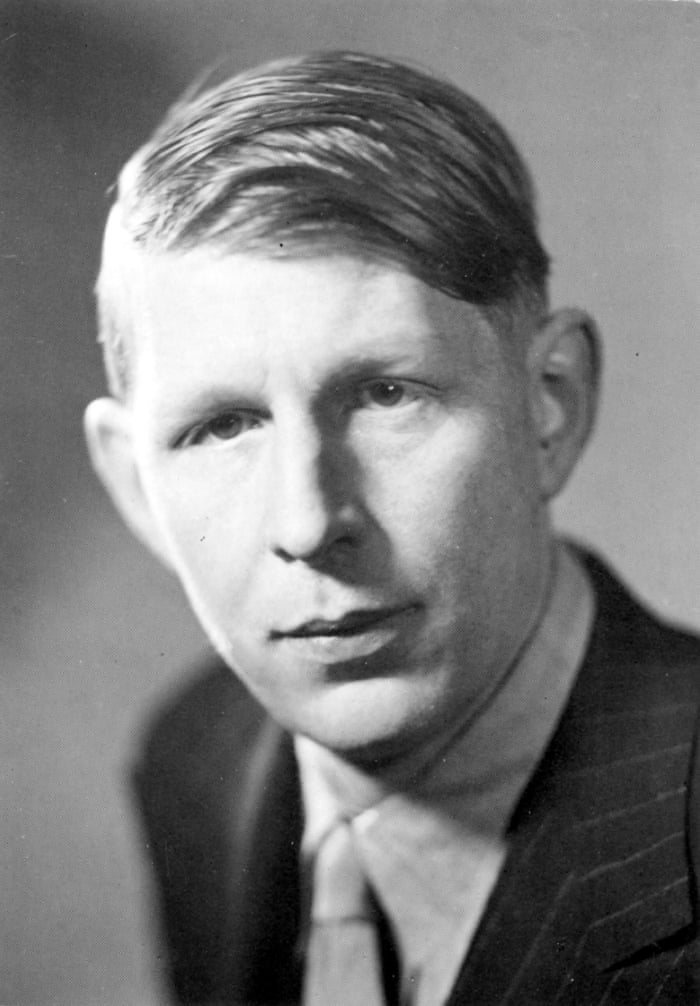
W.H. Auden
English
1907 – 1973
Lay your sleeping head, my love, Human on my faithless arm; Time and fevers burn away Individual beauty from Thoughtful children, and the grave Proves the child ephemeral: But in my arms till break of day Let the living creature lie, Mortal, guilty, but to me The entirely beautiful.
Soul and body have no bounds: To lovers as they lie upon Her tolerant enchanted slope In their ordinary swoon, Grave the vision Venus sends Of supernatural sympathy, Universal love and hope; While an abstract insight wakes Among the glaciers and the rocks The hermit’s carnal ecstasy.
Certainty, fidelity On the stroke of midnight pass Like vibrations of a bell, And fashionable madmen raise Their pedantic boring cry: Every farthing of the cost, All the dreaded cards foretell, Shall be paid, but from this night Not a whisper, not a thought, Not a kiss nor look be lost.
Beauty, midnight, vision dies: Let the winds of dawn that blow Softly round your dreaming head Such a day of welcome show Eye and knocking heart may bless, Find the mortal world enough; Noons of dryness find you fed By the involuntary powers, Nights of insult let you pass Watched by every human love.
We present this work in honor of the 50th anniversary of the poet’s death.
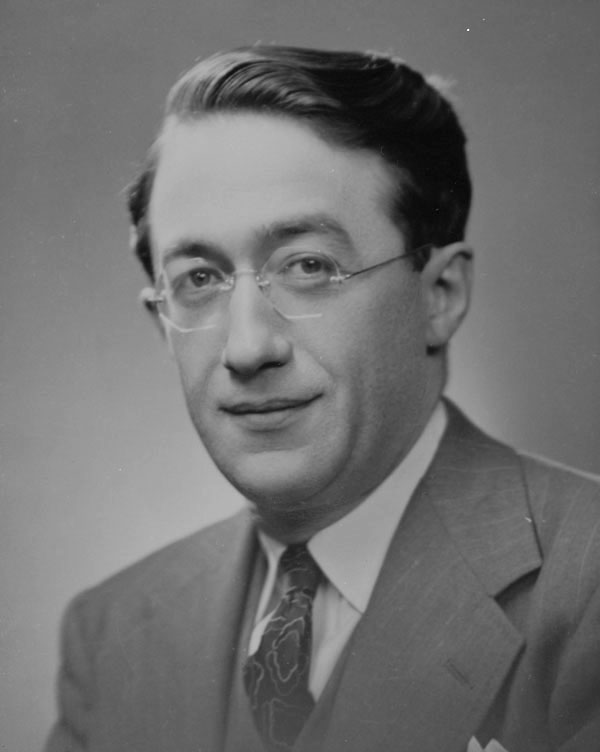
A.M. Klein
Canadian
1909 – 1972
Bundled their bones, upon ninety-nine stairs – St. Joseph’s ladder – the knobs of penance come, the folded cripples counting up their prayers.
How rich, how plumped with blessing is that dome! The gourd of Brother André! His sweet days rounded! Fulfilled! Honeyed to honeycomb!
Whither the heads, upon the ninety-nine trays, the palsied, who double their aspen selves, the lame, the unsymmetrical, the dead-limbed, raise
their look, their hope, and the idée fixe of their maim, knowing their surgery’s in the heart. Are not the ransomed crutches worshipers? And the fame
of the brother sanatorial to this plot? God mindful of the sparrows on the stairs? Oh, to their faith this mountain of stairs, is not!
They know, they know, that suddenly their cares and orthopedics will fall from them, and they will stand whole again. Roll empty away, wheelchairs, and crutches, without armpits, hop away!
And I who in my own faith once had faith like this,
We present this work in honor of the 70th anniversary of the poet’s death.
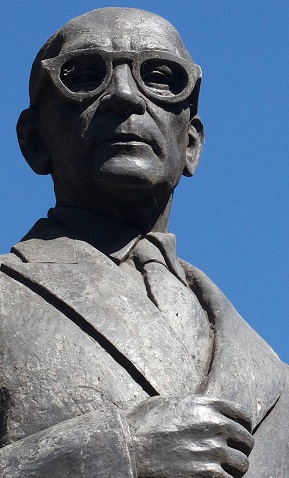
Enrique Gonzalez Martinez Mexican 1871 – 1952
Its gaze filled my abyss, its gaze melted into my being, became so mine that I am doubtful if this breath of agony is life still or hallucinated death.
The archangel came, cast his sword upon the double laurel flourishing in the sealed garden….And that day brought back the shadow and I returned to my nothingness.
I thought the world, witnessing man’s appal, would crumble, overwhelmed beneath the ruins of the entire firmament crashing down.
But I saw the earth at peace, at peace the heavens, the fields serene, limpid the running stream, blue the mountain and the wind at rest.
I heard a bird at dawn Singing sweetly on a tree, That the dew was on the lawn, And the wind was on the lea; But I didn’t listen to him, For he didn’t sing to me.
I didn’t listen to him, For he didn’t sing to me That the dew was on the lawn And the wind was on the lea; I was singing at the time Just as prettily as he.
I was singing all the time, Just a prettily as he, About the dew upon the lawn And the wind upon the lea; So I didn’t listen to him As he sang upon a tree.
I am a bourgeois lady and have a swollen belly. I try to write my thoughts despite my sore throat.
I behave the way some others want. In common ground, the standard lie. But, for human beings it is despicable to bear labels which say: “Dry clean only.” “Handle with care.”
I have been a prodigious child, a little brat, a bad student, a beauty queen, a fashion model, and one of those that advertise soups or sundries.
I got myself into this inevitable mess, by falling in love, then sacrificing a handsome man, turning him into a husband, a sad situation.
(Not to mention what kind of person I have become!)
I have committed an inconvenient social crime: adding five children to the crowd.
I have failed as a mother, and a wife, as a lover, as a reader of philosophy.
All I can do, with sad mediocrity, is to be a bourgeois wife, unforgivably inconsequential, deaf and blind: a useless kind of human mind.
And that is why I always have a swollen belly, and sometimes I want to scream with such anger, that my own raging words do irritate my throat.
Then I write poetry which has the sound of a bass cord inside my core. Because I know the truth: that there’s a war, and violence, and crime each single day, while I am at the same time sitting here with no fear… For dumb, so doomed. For deaf So damned.
Not knowing what to do I choose inertia. I look the other way. But inside myself, I cry. Because I remember the hunger, the children in tears watching us with open eyes… far away or near, the children as real as I.
At exactly the same hour we the ladies, the socialites keep sitting here blinded, surrounded by disposable happiness.
I do nothing to see if we can move the world against poverty and drugs, against violence and war!
Instead there’s this insanity, staying still, contented with being just ass holes.
We present this work in honor of the 55th anniversary of the poet’s death.
Forough Farrokhzad Persian 1935 – 1967
I shed my clothes in the lush air to bathe naked in the spring water, but the quiet night seduced me into telling it my gloomy story.
The water’s cool shimmering waves moaned and lustily surrounded me, urged with soft crystal hands my body and spirit into themselves.
A far breeze hurried in, poured a lapful of flowers in my hair, breathed into my mouth Eurasian mint’s pungent, heart-clinging scent.
Silent and soaring, I closed my eyes, pressed my body against the soft young rushes, and like a woman folded into her lover’s arms gave myself to the flowing waters.
Aroused, parched, and fevered, the water’s lips rippled trembling kisses on my thighs, and we suddenly collapsed, intoxicated, gratified, both sinners, my body and the spring’s soul.
We are the miracles that God made To taste the bitter fruit of Time. We are precious. And one day our suffering Will turn into the wonders of the earth.
There are things that burn me now Which turn golden when I am happy. Do you see the mystery of our pain? That we bear poverty And are able to sing and dream sweet things
And that we never curse the air when it is warm Or the fruit when it tastes so good Or the lights that bounce gently on the waters? We bless things even in our pain. We bless them in silence.
That is why our music is so sweet. It makes the air remember. There are secret miracles at work That only Time will bring forth. I too have heard the dead singing.
And they tell me that This life is good They tell me to live it gently With fire, and always with hope. There is wonder here
And there is surprise In everything the unseen moves. The ocean is full of songs. The sky is not an enemy. Destiny is our friend.
My friend is married to a man married also to another. He divides his life fairly and squarely between them, One half for my friend and the second half for the other woman. A married man once came to me and said ‘I love you.’ I asked him what he wanted. He said a lawful wife in accordance with God’s precepts. I said being a whole woman I could not accept half a man. He went livid and accused me of heresy. Pointing his gun at my head, he said, ‘Death to the woman who does not know God.’ So I pointed my gun at his head saying, ‘Death to the half men.’ So he retracted and went back to his wife.
We present this work in honor of the 50th anniversary of the poet’s death.
Marianne Moore
American
1887 – 1972
The illustration is nothing to you without the application. You lack half wit. You crush all the particles down into close conformity, and then walk back and forth on them.
Sparkling chips of rock are crushed down to the level of the parent block. Were not ‘impersonal judgment in aesthetic matters, a metaphysical impossibility,’ you
might fairly achieve It. As for butterflies, I can hardly conceive of one’s attending upon you, but to question the congruence of the complement is vain, if it exists.





 Poets Corner