We present this work in honor of the poet’s 30th birthday.
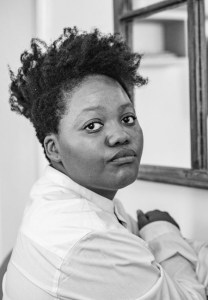
South African
b. 1993
The mirror spits your grandmotherback at you.
Her determinedeyes.
Her machetemouth.
Her howling courage.
You are third-generation
Messiah.
We present this work in honor of the poet’s 30th birthday.
The mirror spits your grandmotherback at you.
Her determinedeyes.
Her machetemouth.
Her howling courage.
You are third-generation
Messiah.
We present this work in honor of Human Rights Day.

To be a jacket
To be a slave
To be a stepladder
To be forsaken
For you to understand
You must have a disability
To be a breast of money
For those who are abled
And be the belt
For civil servants
And be a grass mat for feet
The feet of the rich
The feet of the wealthy
For you to understand
You must have a disability
And ask for help day and night
No one will listen
The government and community
They all emphasise
They emphasise your worthlessness
And you also feel worthless
But for you to understand
You must have a disability
Discrimination has become obvious
To be undermined
People see a disability
And do not see a person
But for you to understand
You must have a disability
We present this work in honor of the 10th anniversary of the poet’s death.
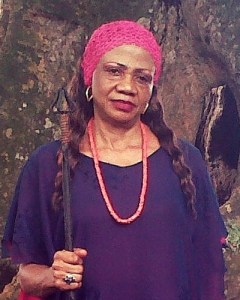
I can still recall their laughter
As they spoke of ‘lost virtue’.
I, Obiajunu
I have learned to live in scarcity.
So, cautiously,
i choose my steps
labouring up the steep hill
bearing on my head
in a clay pot
the spring’s very last drop
but from the bushes
a sweet melody
streams forth
and fills my ears
disarming
tantalising
and the body
is tempted to sway
leading the feet
off the straight path
and the eyes
are tempted to stray
to find the source
the giver of temporal joy
but i must hold fast
my pot of spring water
Though the seller of clay pot
never makes the ‘customer’
though the carrier of clay pot
be the mother of an only son
and though this tune
vibrating in my ears
tempts me to dance
to sway my hips
in unison
with it
beguiling
yet i cannot lose it
this stem
this prop
i have laboured up this hill
through toil and sweat
and i cannot spill it
this water so pure
so clear and sweet
the dying spring’s last drop
i obianuju
i shall provide my children
with plenty
i shall multiply this drop
they will never taste
of the wasted fluid
of the sea

Boundless
For when we were
Young and playful,
Our joyous laughter
Rang out echoes through
Every street,
Enlivened by our boundless
Youthfulness.
For when we were
Young and playful,
We would jump buses
Standing or moving,
Ticketless to nowhere
And everywhere,
Knowing no limits,
Knowing no particular
Place to get off.
For when we were
Young and playful,
I met a stranger then,
Caring little about
His looks,
Just being young
Curious and fearless
On a moving empty
London bus,
But for us restless
Young and playful ones,
Filling up, No,
Taking over an
Empty London bus
To make life anew,
Posing, loving us
And strangers in
Boundless youthfulness,
Knowing not,
Caring little
What we were,
What we are
Going to become.
We present this work in honor of the poet’s 65th birthday.

Do not say “absence tastes like madness”
Close your eyes
Wherever you are
You will find me…
Immovable as the sea
Wandering about
In the ebb and flow
Never absent.

She was the nameless woman who created
images of her children sold away from her.
She suspended her wood babies from a rope
round her neck, before she ate she fed them.
Touched bits of pounded yam and plantains
to sealed lips, always urged them to sip water.
She carved them of wormwood, teeth and nails
her first tools, later she wielded a blunt blade.
Her spit cleaned faces and limbs; the pitch oil
of her skin burnished them. When woodworms
bored into their bellies she warmed castor oil
they purged. She learned her art by breaking
hard rockstones. She did not sign her work.

A tear drop alights
From a car that crosses my eye
And stops
Behind a light that embodies red
And then drops
into bumps and coughs
And pulls a hand break
Stop!
Like a light that turns amber
When the street is quiet
If I don’t run away
In these high heels
To the last light
Someone would want to give me a ride
With hands that go green
like a bud in my eyes
And then blow cigarette smoke
Into my eyes
What a passengerless destiny
My poor tears
Are shot again
My eyes
Got their period again

At oldest moon the tanker is aimed at shore
and scuttled like a much smaller thing;
its prow cocked in the unnatural questioning
of a carcass head; its waterlines, doing marked done.
Empty oil-barrels thrown to sea, herded to shore,
then the loosest fittings, then steeliest ego-structure:
all parts can be turned to mutiny in the end.
In the hull’s darkness a man, as taken as Jonah,
falls off a girder and ends forty feet below,
straddling a crossbeam that splits his pelvis in two.
We present this work in honor of the poet’s 25th birthday.

The announcement
Swung blunt as an axe-blow:
All students were to leave
Campus as soon as possible.
We think we cried,
Our brains bleached blank.
We were already trying to forget
What we would live.
What we would give.
Beware the ides of March.
We recognized that something ran
Rampant as a rumor
Among our ranks.
Cases bleeding closer,
Like spillage in a napkin.
There is nothing more worrisome
Than a titan who believes itself
Separate from the world.
Graduation day.
We don’t need a gown.
We don’t need a stage.
We are walking beside our ancestors,
Their drums roar for us,
Their feet stomp at our life.
There is power in being robbed
& still choosing to dance.

In the old house
where my grandfather composed his formal poems
I live as a concubine in my kingdom,
my dress is wet,
and on my head I place a crown.
In the old house
where the jug is tilted
water seeps out
mixed with prayers.
In the old house
where my first cry echoed,
I spread the soil of lineage
for us to sleep on,
one soul stacked next to another.
In the old house
where my grandmother was throned a bride
I search for her shawl
and place it for my shoulders to kiss.
In the old house
I cross ancient nights
and carry food to dervishes.
In the old house
I hand away my embers as a dowry
to lovers bathing in rain.
In the old house
Love wears us like a cape
and the courtyard becomes
twice its size.
 Poets Corner