Limits

In honor of the Argentine holiday, National Flag Day, we present this work by Argentina’s most legendary author.
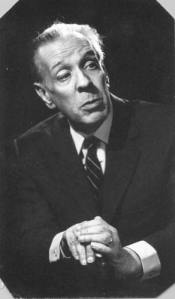
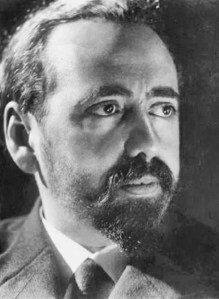
Jorge Luis Borges
Argentine
1899 – 1986


Among these streets that deepen the red west
There must be one I’ve gone along not knowing
That that time, in that street, will have been my last—
Both unconcerned and unaware, obeying

The great Whoever-It-Is that sets a term,
A secret and inviolable end,
To every shadow, every dream and form
That ravels life and knits it up again.

And if for all there is a norm and measure,
A last time, a nevermore, and a forgetting,
Who can tell which visitor, departing,
Is one to whom we’ve said goodbye forever?

Beyond the greying window night is fading
And in the stack of books whose lopped shadow
Makes it seem taller on the dim-lit table,
There’s one we’ll never get around to reading.

There are on the Southside more than one ruined dooryard
With prickly pear and rubble masonry planters
Where I shall no more be allowed to enter
Than if it were a picture on a postcard.

There is a door that you have closed for good,
A mirror that waits in vain to hold your face;
A four-faced Janus guards your next crossroad
Though it seems you might go any of its ways.

In the midst of all your memories there is one
Faded away beyond recovering;
Neither the yellow moon nor the white sun
Will ever see you drinking from that spring.

Your voice will not recapture what the Persian
Said in his tongue of rose and nightingale
When you may wish at dusk, as the light disperses,
To say things that are unforgettable.

And the everflowing Rhône, and certain lake,
All that is present to me from the past,
Will sink like Carthage that the Roman took,
Destroyed with fire and with salt erased.

I believe I hear in the dawn the strenuously
Long murmur of a multitude departing.
They are what has loved me and forgotten.
Space, time, and Borges are deserting me.
Memorandum 13,874

In honor of the Argentine holiday of May Day Revolution, we present this work by one of Argentina’s most delightfully subversive poets.

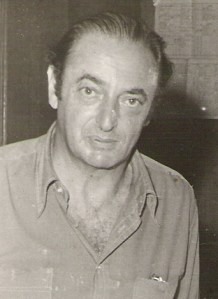
Humberto Costantini
Argentine
1924 – 1987


Dear boss,
I’m writing to inform you that,
having now completed 20 years of continuous work in this office,
it is imperative, if I am to proceed with this task,
that you send me, at your very earliest convenience,
the items I list below:

A grey sky, some low clouds and an autumn day, if possible.
And a lot of very old trees…
casuarinas, as dark as time.

Would it be too much to ask for some poplars as well?
And dampness,
a slow drizzle – and earth,
definitely earth,
and the smell of earth and autumn and trees.

You could perhaps omit dry leaves,
but not the heart on fire,
nor the blood full of birdsong;
and don’t leave out vertigo either
or the blond girl at my side with all her tenderness,
or the blood filling with birds…

Nocturne

Oliverio Girondo
Argentine
1891 – 1967


Cool glass, when leaning forehead against window.
Late-night lights go out, leaving us even lonelier.
Spiderwebs woven by wires over rooftops.
Hollow trot of passing nags touches us for no reason.

What does the howl of these cats in heat call to mind,
and what can the scraps of paper be plotting
as they slither onto empty patios?

The time of night when old furniture seizes the chance to shed its lies,
when pipes make strangulated cries, as though suffocating inside the walls.

Now and then we think, when flipping the electric light switch,
of the fright the shadows must feel, and we’d like to warn them
so they have time to curl up in the corners.
And now and then there is something sinister
about the telephone-pole crosses over the rooftops,
and one wants to slink along the walls like a cat or a thief.

Nights when we wish for a hand to caress our lower back,
when we suddenly realize that no tenderness compares
to stroking something as it sleeps.

Silence!—voiceless cricket that hops in our ear.
Leaky faucet song!—the only cricket that fits the city.

When the Milonga Cries

In honor of Malvinas Day, we present this work by one of the finest poets of 20th century Argentina.

Maria Luisa Carnelli
Argentine
1898 – 1987


The bandoneón wept
sorrows that the fall of night
takes away.
And just like a heart,
the hollow hallway
picks up a sad, faithful
woman’s prayer.

The milonga cried
over its old passion,
it seems to be begging
comfort and forgiveness.
The shadow went
through the arrabal
of he, whose dagger
played with death.

Two old people
together in an alley
raise their hands
to their salvation.
And all the suburb,
with grief,
evokes a deep
love drama.

The military call
with its prolongued tremble
shook the arrabal.
With great sorrow and feeling,
sentimental pain
overcomes the woman
as the bandoneon
prays of a love.