We present this work in honor of the poet’s 80th birthday.
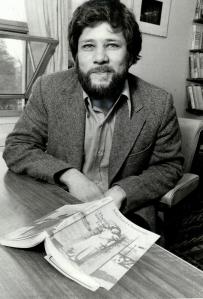
Michael Ondaatje Canadian b. 1943
A girl whom I’ve not spoken to or shared coffee with for several years writes of an old scar. On her wrist it sleeps, smooth and white, the size of a leech. I gave it to her brandishing a new Italian penknife. Look, I said turning, and blood spat onto her shirt.
My wife has scars like spread raindrops on knees and ankles, she talks of broken greenhouse panes and yet, apart from imagining red feet, (a nymph out of Chagall) I bring little to that scene. We remember the time around scars, they freeze irrelevant emotions and divide us from present friends. I remember this girl’s face, the widening rise of surprise.
And would she moving with lover or husband conceal or flaunt it, or keep it at her wrist a mysterious watch. And this scar I then remember is a medallion of no emotion.
I would meet you now and I would wish this scar to have been given with all the love that never occurred between us.
We present this work in honor of the Canadian holiday, Civic Day.
Susanna Moodie Canadian 1803 – 1885
The Northern Lights are flashing On the rapids’ restless flow, But o’er the wild waves dashing Swift darts the light canoe: The merry hunters come,— “What cheer? What cheer?” We ’ve slain the deer!” “Hurrah! you ’re welcome home!”
The blithesome horn is sounding, And the woodman’s loud halloo; And joyous steps are bounding To meet the birch canoe. “Hurrah! the hunters come!” And the woods ring out To their noisy shout, As they drag the dun deer home!
The hearth is brightly burning, The rustic board is spread; To greet their sire returning The children leave their bed. With laugh and shout they come, That merry band, To grasp his hand And bid him welcome home!
Here the tides flow, And here they ebb; Not with that dull, unsinewed tread of waters Held under bonds to move Around unpeopled shores— Moon-driven through a timeless circuit Of invasion and retreat; But with a lusty stroke of life Pounding at stubborn gates, That they might run Within the sluices of men’s hearts, Leap under throb of pulse and nerve, And teach the sea’s strong voice To learn the harmonies of new floods, The peal of cataract, And the soft wash of currents Against resilient banks, Or the broken rhythms from old chords Along dark passages That once were pathways of authentic fires.
Red is the sea-kelp on the beach, Red as the heart’s blood, Nor is there power in tide or sun To bleach its stain. It lies there piled thick Above the gulch-line. It is rooted in the joints of rocks, It is tangled around a spar, It covers a broken rudder, It is red as the heart’s blood, And salt as tears.
Here the winds blow, And here they die, Not with that wild, exotic rage That vainly sweeps untrodden shores, But with familiar breath Holding a partnership with life, Resonant with the hopes of spring, Pungent with the airs of harvest. They call with the silver fifes of the sea, They breathe with the lungs of men, They are one with the tides of the sea, They are one with the tides of the heart, They blow with the rising octaves of dawn, They die with the largo of dusk, Their hands are full to the overflow, In their right is the bread of life, In their left are the waters of death.
Scattered on boom And rudder and weed Are tangles of shells; Some with backs of crusted bronze, And faces of porcelain blue, Some crushed by the beach stones To chips of jade; And some are spiral-cleft Spreading their tracery on the sand In the rich veining of an agate’s heart; And others remain unscarred, To babble of the passing of the winds.
Here the crags Meet with winds and tides— Not with that blind interchange Of blow for blow That spills the thunder of insentient seas; But with the mind that reads assault In crouch and leap and the quick stealth, Stiffening the muscles of the waves. Here they flank the harbours, Keeping watch On thresholds, altars and the fires of home, Or, like mastiffs, Over-zealous, Guard too well.
Tide and wind and crag, Sea-weed and sea-shell And broken rudder— And the story is told Of human veins and pulses, Of eternal pathways of fire, Of dreams that survive the night, Of doors held ajar in storms.
We present this work in honor of the poet’s 105th birthday.
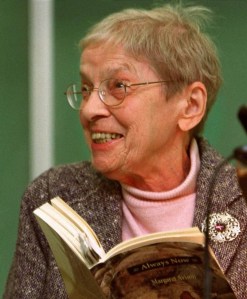
Margaret Avison Canadian 1918 – 2007
The dervish dancer on the smoking steppes Unscrolled, into the level lava-cool Of Romish twilight, baleful hieroglyphs That had been civic architecture, The sculptured utterances of the Schools.
The Vikings rode the tasseled sea: Over their shoulders, running towards their boats, They had seen the lurking matriarchal wolves, Ducked their bright foreheads from the iron laurels Of a dark Scandinavian destiny, And chosen, rather, to be dwarfed to pawns Of the broad sulking sea.
And Lampman, when he prowled the Gatineau: Were the white vinegar of northern rivers, The stain of punkwood in chill evening air, The luminous nowhere past the gloomy hills, Were these his April cave— Sought as the first men, when the bright release Of sun filled them with sudden self-disdain At bone-heaps, rotting pelts, muraled adventures, Sought a more primitive nakedness?
The cave-men, Lampman, Lief, the dancing dervish, Envied the fleering wolf his secret circuit; But knew their doom to propagate, create, Their wild salvation wrapt within that white Burst of pure art whose only promise was Ferocity in them, thudding its dense Distracting rhythms down their haunted years.
I remember when the unicorns roved in herds through the meadow behind the cabin, and how they would lately pause, tilting their jewelled horns to the falling sun as we shared the tensions of private property and the need to be alone.
Or as we walked along the beach a solitary delicate beast might follow on his soft paws until we turned and spoke the words to console him.
It seemed they were always near ready to show their eyes and stare us down, standing in their creamy skins, pink tongues out for our benevolence.
As if they knew that always beyond and beyond the ladies were weaving them into their spider looms.
I knew where they slept and how the grass was bent by their own wilderness and I pitied them.
It was only yesterday, or seems like only yesterday when we could touch and turn and they came perfectly real into our fictions. But they moved on with the courtly sun grazing peacefully beyond the story horns lowering and lifting and lowering.
I know this is scarcely credible now as we cabin ourselves in the cold and the motions of panic and our cells destroy each other performing music and extinction and the great dreams pass on to the common good.
We present this work in honor of the poet’s 100th birthday.
Chava Rosenfarb Canadian 1923 – 2011
I would sew a dress for you, my child, out of tulle made of spring’s joyful green, and gladly crown your head with a diadem made of the sunniest smiles ever seen.
I would fit out your feet with a pair of crystal-like, weightless, dance-ready shoes, and let you step out of the house with bouquets, bright with the promise of pinks and of blues.
But outside it is cold and dreary, my child, the wanton winds lurking unbridled and wild. They will mangle the dress of joy into shreds and sweep the sun’s smiling crown off your head,
Shatter to dust the translucent glass of your shoes and bury in mud the dreams of pinks and of blues. From far away I can hear you call me and moan: “Mother, mother, why did you leave me alone?”
So perhaps I should sew a robe for you, my child, out of the cloak of my old-fashioned pain, and alter my hat of experience for you to shelter you from the ravaging rain?
On your feet I would put my own heavy boots, the soles studded with spikes from my saviourless past and guide your way through the door with a torchlight of wisdom I’ve saved till this hour of dusk.
But outside it is cold and dreary, my child. The wanton winds lurking unbridled and wild will rip up the robe sewn with outdated thread, bare your chest to all danger, to fear bare your head.
The heavy boots will sink in the swamp and will drown, the light of wisdom mocked by the laugh of a clown. From afar I hear you call me and moan: “Mother, mother, why did you leave me alone?”
What a wretched seamstress your mother is— Can’t sew a dress for her child! All she does is prick her clumsy fingers, cross-stitching her soul, while her eyes go blind.
The only thing that I can sew for you, my sweet, my golden child, is a cotton shift of the love I store in my heart. The only thing I can give to light your way are my tears of blessing; I have nothing more.
So I must leave you outside, my child, and leave you there alone. Perhaps dressed in clothing of love you will learn better how to go from home. So I sit here and sew and sew, while in my heart I hope and pray— my hands, unsteady, tremble; my mind, distracted, gone astray.
We present this work in honor of the poet’s 90th birthday.
Alden Nowlan Canadian 1933 – 1983
The orchestra playing the last waltz at three o’clock in the morning in the Knights of Pythias Hall in Hartland, New Brunswick, Canada, North America, world, solar system, centre of the universe—
and all of us drunk, swaying together to the music of rum
We present this work in honor of the 105th anniversary of the poet’s death.
William Wilfrid Campbell Canadian 1858 – 1918
Out in a world of death far to the northward lying, Under the sun and the moon, under the dusk and the day; Under the glimmer of stars and the purple of sunsets dying, Wan and waste and white, stretch the great lakes away.
Never a bud of spring, never a laugh of summer, Never a dream of love, never a song of bird; But only the silence and white, the shores that grow chiller and dumber, Wherever the ice winds sob, and the griefs of winter are heard.
Crags that are black and wet out of the grey lake looming, Under the sunset’s flush and the pallid, faint glimmer of dawn; Shadowy, ghost-like shores, where midnight surfs are booming Thunders of wintry woe over the spaces wan.
Lands that loom like spectres, whited regions of winter, Wastes of desolate woods, deserts of water and shore; A world of winter and death, within these regions who enter, Lost to summer and life, go to return no more.
Moons that glimmer above, waters that lie white under, Miles and miles of lake far out under the night; Foaming crests of waves, surfs that shoreward thunder, Shadowy shapes that flee, haunting the spaces white.
Lonely hidden bays, moon-lit, ice-rimmed, winding, Fringed by forests and crags, haunted by shadowy shores; Hushed from the outward strife, where the mighty surf is grinding Death and hate on the rocks, as sandward and landward it roars.
We present this work in honor of the 75th anniversary of the poet’s death.
Duncan Campbell Scott Canadian 1862 – 1947
A deep bell that links the downs To the drowsy air; Every loop of sound that swoons, Finds a circle fair, Whereon it doth rest and fade; Every stroke that dins is laid Like a node, Spinning out the quivering, fine, Vibrant tendrils of a vine: (Bim – bim – bim.) How they wreathe and run, Silvern as a filmy light, Filtered from the sun: The god of sound is out of sight, And the bell is like a cloud, Humming to the outer rim, Low and loud: (Bim – bim – bim.) Throwing down the tempered lull, Fragile, beautiful: Married drones and overtones, How we fancy them to swim, Spreading into shapes that shine, With the aura of the metals, Prisoned in the bell, Fulvous tinted as a shell, Dreamy, dim, Deep in amber hyaline: (Bim – bim – bim.)



 Poets Corner