We present this work in honor of the poet’s 150th birthday.
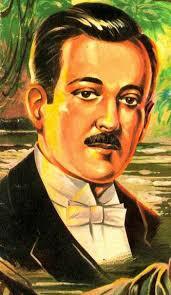
Guilldermo Valencia Colombian 1873 – 1943
That I love you, without rival, you knew it and the Lord knows it; never flirt the erratic grass to the friendly forest how your being joined my sad soul
And in my memory your life persists with the sweet murmur of a song already the nostalgia of your love mitigates my mourning that resists oblivion.
Diaphanous spring that does not run out, you live in me and in my austere aridity your freshness mixes drop by drop.
You went to my desert the palm tree, To my bitter skin the seagull, And you will only die when I die!
We present this work in honor of the poet’s 100th birthday.
Álvaro Mutis Colombian 1923 – 2013
Tequila is a clean flame that clambers up the walls and shoots over tiled roofs, relief to despair. Tequila isn’t for sailors because it blurs the navigational instruments and dismisses the wind’s tacit orders. But tequila, on the other hand, enraptures those returning by train and those driving the train, because it stays faithful and blind in its loyalty to the rails’ parallel delirium and to hurried greetings in the stations where the train pauses to testify to its inscrutable destination, errant, subject to the inevitable laws. There are trees under whose shadow it is wonderful to drink it with the parsimony of those who preach in wind and other trees where tequila can’t stand the shade that dims its powers and in whose branches it stirs up a flower blue as the warnings on bottles of poison. When tequila waves its fringed, serrated flag, the battle halts and armies return the order they intended to impose. Often two squires accompany it: salt and lime. But it is always ready to start the conversation without any more help than its lustrous clarity. From the start, tequila doesn’t recognize borders. But there are propitious climates just as certain hours suggest it, knowing full well: to fix the time when night arrives at its stores, in the splendor of an afternoon without obligations, in the highest pitch of doubt and hesitation. It is then when tequila offers us its consoling lesson, its infallible joy, its unreserved indulgence. Also, there are foods that call for its presence: those springing from the ground from which it, too, was born. Inconceivable if they didn’t bond with millenary certainty. To break that pact would be a grave breach with dogma prescribed to allay the rough job of living. If “gin smiles like a dead girl,” tequila spies on us with the green eyes of a prudent sentry. Tequila has no history, no anecdote confirming its birth. It is so from the beginning because it is the gift of the gods and, usually, when they promise something they aren’t telling tales. That is the office of mortals, children of panic and habit. Such is tequila and so it will be keeping us company all the way to the silence from which no one returns. Praise be, then, until the end of our days and praise the daily effort toward denying that end.
We present this work in honor of Colombian Independence Day.
Jorge Gaitán Durán Colombian 1924 – 1962
Death could not beat me. I battled and lived. The restless body against the soul, to the white flight of the day.
In the ruins of Troy I wrote: “Everything is death or love” and since then I had no rest. I said in Rome:
“There are no gods, just time” and since then I had no redemption. I silenced myself in Spain, since the voice of rage defied forgetfulness with my marrow, my humors, my blood; and since then the fire has not stopped.
May the foreign land serve as a resting place for the hero. May fresh grass sing like a bee of the dust by his eyelids. I do not surrender: I want to live in war every day, as if it were the last one.
They say the last flame will ignite in the ocean. In the belly of the whale that houses the forgotten myths, in its song, conjuring the return of the gods. But I stored away some matches to safeguard the flames of the earth.
In honor of St. Joseph’s Day, we present this work by one of today’s most spirited Colombian poets.
Andrea Cote-Botero Colombian b. 1981
Also remember, María, four in the afternoon in our scorched port. Our port that was more a stranded bonfire or a wasteland or a lightning flash. Remember the burning ground, us girls scratching the earth’s back as if to disinter the green meadow. The lot where they were serving the snack, our plate brimming with onions salted by my mother, fished by my father. But despite all that, you know well, we would have liked to invite God to preside at our table, God but without a word without miracles and only so you would know, María, that God is everywhere as well as in your plate of onions although it makes you cry.
But above all remember me and the wound, before they grazed from my hands in the wheatfield of onions to make from our bread the hunger of all our days so that now that you no longer remember and the bad seed feeds the wheatfield of the missing I discover you, María, which is not your fault nor the fault of your forgetting, for this is the time and this its task.
We present this work in honor of the poet’s 135th birthday.
José Eustasio Rivera Colombian 1888 – 1928
Simple singer of a great discontent, Among the shrubs the canopy keeps hidden, Troubling the foliage with soft lament, Nibbling myrtle, sour grape pips – wood pigeon!
Sings coo-roo-roo, glimpsing day’s first ascent And later evening’s brief reflected vision, Sees from the gúaimaro’s¹ overspreading tent Silent peace fill the slopes, that tree’s dominion.
Half-open the wings iridescent in the light, Solitude – poor soul! – saddens its delight, And it fluffs up its head feathers, a light hood.
To the maternal heartbeat of domains it holds In its own entrails, it croons to mountains, folds Them in sleep; light drowns in a dark wood.
We present this work in honor of the 160th anniversary of the poet’s death.
Julio Arboleda Pombo Colombian 1817 – 1862
Unhappy who seeks in appearance bliss and ephemeral praise, and changes his mind with the change of the versatile public conscience!
The present is your only providence; yields to the blowing of the wind that throws him to good without faith and evil without hope; that in erring with the world is his science.
And happy the independent male who, free from worldly bondage, aspires, between pain and sorrow,
to the eternal truth, not to the present one, knowing that the world and its truths they are only vanity of vanities!





 Poets Corner