We present this work in honor of the Japanese holiday, Culture Day.

Japanese
c. 700 – 750
When the tide is high
Flooding the rocky shore,
As the seaweed is he?
Seldom glimpsed, but
Much desired!
We present this work in honor of the Japanese holiday, Culture Day.
When the tide is high
Flooding the rocky shore,
As the seaweed is he?
Seldom glimpsed, but
Much desired!

Autumn Moon
Fearing my past is exposed
to the moon,
I keep looking down
this evening.
We present this work in honor of the Japanese holiday, Mountain Day.

To speed my brother
Parting for Yamato,
In the deep of night I stood
Till wet with the dew of dawn.
The lonely autumn mountains
Are hard to pass over
Even when two go together-
How does my brother cross them all alone!
We present this work in honor of the 40th anniversary of the poet’s death.
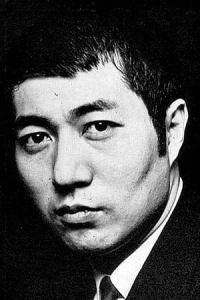
Whenever I am melancholy I go out to watch the sea
Heading home from a used bookstore I go out to watch the sea
Whenever you are sick in bed I go out to watch the sea
On mornings my soul is wearing thin I go out to watch the sea
Oh, the sea!
Large shoulders and broad chest!
However cruel the morning, however brutal the night
It will come to an end
All life will someday end
Only the sea will remain
Whenever I am melancholy I go out to watch the sea
On the loneliest of nights I go out to watch the sea
We present this work in honor of the poet’s 120th birthday.
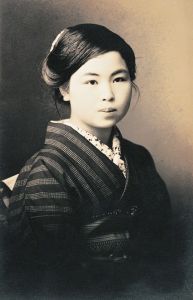
Suddenly, I recall that town—
the red rooftops along the river bank;
and then, on the waters of that broad blue river
a white sail—quietly, quietly moving;
and on the grass of the riverbank
a young man, an artist
idly staring at the water.
And I? What was I doing?
When I think I can’t remember,
I realize it was all a picture in a borrowed book.
Translation by David Jacobson, Sally Ito, and Michiko Tsuboi
We present this work in honor of the Vernal Equinox.

In the loneliness of my heart
I feel as if I should perish
Like the pale dew-drop
Upon the grass of my garden
In the gathering shades of twilight.
We present this work in honor of the 675th anniversary of the poet’s death.

Who travels the Way heeds the Heart’s and the Way’s beginnings,
But the Way’s everywhere, without boundaries —
I’ll go till the rivers run dry, exhaust the peaks:
In the calm of the clouds I’ll sit, and watch the moon light up the heavens.
We present this work in honor of the 1,320th anniversary of the poet’s death.
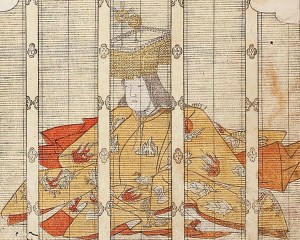
Oh, the autumn foliage
Of the hill of Kamioka!
My good Lord and Sovereign
Would see it in the evening
And ask of it in the morning.
On that very hill from afar
I gaze, wondering
If he sees it today,
Or asks of it tomorrow.
Sadness I feel at eve,
And heart-rending grief at morn –
The sleeves of my coarse-cloth robe
Are never for a moment dry.
We present this work in honor of the poet’s 60th birthday.

Set off to see for myself
my father’s name
carved in a Tohoku museum
Once the “world’s strongest,”
my father’s magnet
crouches on a shelf
Monday morning
the head of the Magnetic Research Institute
picks out his necktie
My father, perfectly at home
with rare earth elements,
loves Modigliani women
“Writing more love poems?”
half humorously
half anxiously
His present—
Sanuki noodles—
comes stuffed in a company envelope
Something warm in the way
he calls his wife “Mother”
without the least hesitation
He wipes his face with a hot towel
and sighs contentedly—
looking at him now I see an ordinary man
Moving away from the telephone
he sips his tea as if to say
“I’m not listening”
Forgiven
their inability to express tenderness—
men of my father’s generation
We present this work in honor of the poet’s 85th birthday.

Mounting a horse with an abundant mane and in glittery armor, a hero
will have to have a face as dazzling as that orb of day.
But a base one ordered to sing of heroes,
I cannot have a face, however ordinary.
Like a photo of the hateful man an abandoned woman tore into shreds,
My face is torn apart and lost in advance.
Faceless, holding in both hands a lyre quite like a face,
on a hill with a view of the field shining with battle dust, under a plane tree,
or on a boulder of a cape overlooking the sea where triremes come and go,
I sit for thousands of years, I just continue to sit.
The odes that, faceless, I sing in praise of passing heroes
overflow as beautiful blood from the chest would I hade with the lyre.
 Poets Corner