We present this work in honor of the 50th anniversary of the poet’s death.
Jack Kerouac American 1922 – 1969
I took a stroll through Roxbury,
enlightenment was obtained, in a meaningless poetic sense.
Homeless men’s faces shout such agony,
they evoke images of tortured souls in a science fiction movie.
Concrete all perfectly disorganized,
like a tile floor at a government building smashed repeatedly by a disgruntled employee.
Cars rush by like ants in their endless toil,
sky leaks darkness upon artificial attempts to beat nature.
Trash lines the street like flaws litter my character.
Trash trucks come and collect these flaws,
take them out of view, so it doesn’t look dirty.
But although this takes it out of public concern,
the trash has to be taken somewhere.
You can’t just will the trash out of existence,
it has to be allowed to fester and decompose.
That’s why the trucks thake the trash off some forgotten highway,
to let it do it’s time removed from first impressions.
So God bless those trash trucks,
because with out them, there would still be the same amount of trash,
but people would be constantly reminded of what a trashy place this is.
Where shall we go for our garlands glad
At the falling of the year,
When the burnt-up banks are yellow and sad,
When the boughs are yellow and sere?
Where are the old ones that once we had,
And when are the new ones near?
What shall we do for our garlands glad
At the falling of the year?
Child! can I tell where the garlands go?
Can I say where the lost leaves veer
On the brown-burnt banks, when the wild winds blow,
When they drift through the dead-wood drear?
Girl! when the garlands of next year glow,
You may gather again, my dear—
But I go where the last year’s lost leaves go
At the falling of the year.
Rise up and look at the mountain, from
where the wind, the sun, the water arrive.
Thou, who determines the course of
rivers, thou who scatters the flight of
your soul.
Rise up. Look at your hands. Join
hands with your brothers, together
in blood we go. Now is the time that
can be tomorrow. Tomorrow.
Deliver us from the men of
misery. Take us to your kingdom of justice and
justice. Blow like the wind the gorge’s flower.
Clean the fire
in the barrel of my gun.
Thy will be done
Here on Earth. Give us your strength and
your courage in combat.
Blow like the wind the field’s daffodil.
Clean fire in the barrel of my gun.
Rise up and look at your hands. Join
hands with your brothers, together
in blood we live,
now and at the hour of
our death. Amen. We live. Amen.
In honor of World Teachers’ Day, we present this work that is often studied in American high schools, written by a poet who made his living as a teacher.
Robert Frost American 1874 – 1963
Something there is that doesn’t love a wall,
That sends the frozen-ground-swell under it,
And spills the upper boulders in the sun;
And makes gaps even two can pass abreast.
The work of hunters is another thing:
I have come after them and made repair
Where they have left not one stone on a stone,
But they would have the rabbit out of hiding,
To please the yelping dogs. The gaps I mean,
No one has seen them made or heard them made,
But at spring mending-time we find them there.
I let my neighbor know beyond the hill;
And on a day we meet to walk the line
And set the wall between us once again.
We keep the wall between us as we go.
To each the boulders that have fallen to each.
And some are loaves and some so nearly balls
We have to use a spell to make them balance:
‘Stay where you are until our backs are turned!’
We wear our fingers rough with handling them.
Oh, just another kind of out-door game,
One on a side. It comes to little more:
There where it is we do not need the wall:
He is all pine and I am apple orchard.
My apple trees will never get across
And eat the cones under his pines, I tell him.
He only says, ‘Good fences make good neighbors.’
Spring is the mischief in me, and I wonder
If I could put a notion in his head:
‘Why do they make good neighbors? Isn’t it
Where there are cows? But here there are no cows.
Before I built a wall I’d ask to know
What I was walling in or walling out,
And to whom I was like to give offense.
Something there is that doesn’t love a wall,
That wants it down.’ I could say ‘Elves’ to him,
But it’s not elves exactly, and I’d rather
He said it for himself. I see him there
Bringing a stone grasped firmly by the top
In each hand, like an old-stone savage armed.
He moves in darkness as it seems to me,
Not of woods only and the shade of trees.
He will not go behind his father’s saying,
And he likes having thought of it so well
He says again, ‘Good fences make good neighbors.’
Since I from Love escaped am so fat,
I ne’er think to be in his prison ta’en;
Since I am free, I count him not a bean.
He may answer, and saye this and that;
I do no force, I speak right as I mean;
Since I from Love escaped am so fat.
Love hath my name struck out of his slat,
And he is struck out of my bookes clean,
For ever more; there is none other mean;
Since I from Love escaped am so fat.
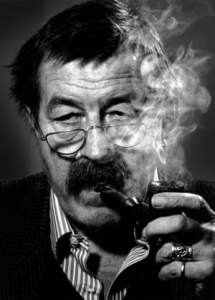
In honor of German Unity Day, we present this work by one of Germany’s greatest modern writers.
Günter Grass German 1927 – 2015
The shoes are at the bottom.
They are afraid of a beetle
On the way out,
Of a penny on the way back,
Of a beetle and a penny on which they might tread
Till it impresses itself.
At the top is the home of the headgear.
Take heed, by wary, not headstrong.
Incredible feathers,
What was the bird called,
Where did its eyes roll
When it knew that its wings were too gaudy?
The white balls asleep in the pockets
Dream of moths.
Here a button is missing,
In this belt the clasp grows weary.
Doleful silk,
Asters and other inflammable flowers,
Autumn becoming a dress.
Every Sunday filled with flesh
And the salt of folded linen.
Before the wardrobe falls silent, turns into wood,
A distant relation of pine-trees,—
Who will wear the coat
One day when you’re dead?
Who move his arm in the sleeve,
Anticipate every movement?
Who will turn up the collar,
Stop in front of the pictures
And be alone under the windy cloche?
Awaken them; they are knobs of sound
that seem to melt and crumple up
like some jellyfish of tropical seas,
torn from sleep with a hand lined by prophecies.
Listen hard; their male, gaunt world sprawls the page
like rows of tree trunks reeking in the smoke
of ages, the branches glazed and dead
as though longing to make up with the sky,
but having lost touch with themselves
were unable to find themselves, hold meaning.
And yet, down the steps into the water at Varanasi,
where the lifeless bodies seem to grow human,
the shaggy heads of word-buds move back and forth
between the harsh castanets of the rain
and the noiseless feathers of summer –
aware that their syllables’ overwhelming silence
would not escape the hearers now, and which
must remain that mysterious divine path
guarded by drifts of queer, quivering banyans:
a language of clogs over cobbles, casting
its uncertain spell, trembling sadly into mist.
We present this work in honor of the Chinese holiday, National Day.
Li Po Chinese 701 – 762
Amongst the grandeur of Hua Shan
I climb to the Flower Peak,
and fancy I see fairies and immortals
carrying lotus in their
sacred white hands, robes flowing
they fly filling the sky with colour
as they rise to the palace of heaven,
inviting me to go to the cloud stage
and see Wei Shu-ching, guardian angel
of Hua Shan; so dreamily I go with them
riding to the sky on the back
of wild geese which call as they fly,
but when we look below at Loyang,
not so clear because of the mist,
everywhere could be seen looting
armies, which took Loyang, creating
chaos and madness with blood
flowing everywhere; like animals of prey
rebel army men made into officials
with caps and robes to match.





 Poets Corner