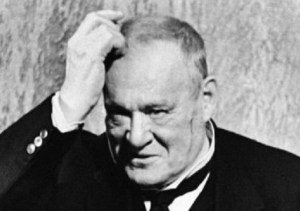
French
1870 – 1953
I shoot the Hippopotamus
With bullets made of platinum,
Because if I use leaden ones
His hide is sure to flatten ‘em.
I shoot the Hippopotamus
With bullets made of platinum,
Because if I use leaden ones
His hide is sure to flatten ‘em.
We present this work in honor of the Japanese holiday, Mountain Day.
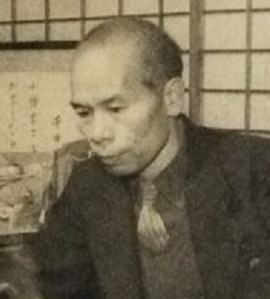
Deep at the bottom of a precipice
a swift stream intensely blue goes bubbling by,
in the unlimited sky beyond
a cable car moves along
burdened by a load that is heavy
and unseen by eyes.
Its thick cable
might be cut off at any unknown time.
Inside myself also
something continually keeps moving along.
Possibly
it might be an express train.
The middle of the night . . .
though almost all noises have faded away,
in the ears’ intensely dark tunnel
there is something hurrying through.
Danger!
Unconsciously shouting,
my own voice awakens me,
the one eye of an intensely red signal
keeps staring at me.
From morning
until late at night
time is regulated by stop-go signals.
Danger!
Larger than an infant’s head,
a single egg
comes rolling down from somewhere
and crosses the street. . . .
Inside the intense darkness
now again
cable cars
are seen to be crossing.
For the sake of public construction work,
I thought, maybe, they were loaded
full of cement,
but with skeletons only
the cable cars were loaded,
one after another
endlessly moving away.
We present this work in honor of Eid al-Adha.

My friend has fled! alas, my friend has fled,
And left me nought but tears and pain behind!
Like smoke above a flame caught by the wind,
So rose she from my breast and forth she sped.
Drunk with desire, I seized Love’s cup divine,
But she that held it poured the bitter wine
Of Separation into it and fled.
The hunter she, and I the helpless prey;
Wounded and sick, round me her toils she drew,
My heart into a sea of sorrow threw,
Bound up her camel loads and fled away.
Fain had I laid an ambush for her soul,
She saw and vanished, and the timid foal,
Good Fortune, slipped the rein and would not stay.
My heart was all too narrow for my woe,
And tears of blood my weeping eyes have shed,
A crimson stream across the desert sped,
Rising from out my sad heart’s overflow.
She knew not what Love’s meanest slave can tell:
“‘Tis sweet to serve!” but threw me a Farewell,
Kissing my threshold, turned, and cried “I go!”
In the clear dawn, before the east was red,
Before the rose had torn her veil in two,
A nightingale through Hafez’ garden flew,
Stayed but to fill its song with tears, and fled.

Always be drunk.
That’s it!
The great imperative!
In order not to feel
Time’s horrid fardel
bruise your shoulders,
grinding you into the earth,
Get drunk and stay that way.
On what?
On wine, poetry, virtue, whatever.
But get drunk.
And if you sometimes happen to wake up
on the porches of a palace,
in the green grass of a ditch,
in the dismal loneliness of your own room,
your drunkenness gone or disappearing,
ask the wind,
the wave,
the star,
the bird,
the clock,
ask everything that flees,
everything that groans
or rolls
or sings,
everything that speaks,
ask what time it is;
and the wind,
the wave,
the star,
the bird,
the clock
will answer you:
“Time to get drunk!
Don’t be martyred slaves of Time,
Get drunk!
Stay drunk!
On wine, virtue, poetry, whatever!”
In honor of Civic Day, we present this work by one of Canada’s most important poets.
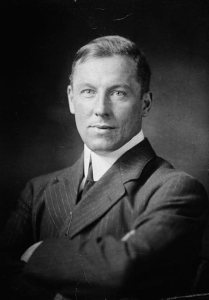
The cruel war was over — oh, the triumph was so sweet!
We watched the troops returning, through our tears;
There was triumph, triumph, triumph down the scarlet glittering street,
And you scarce could hear the music for the cheers.
And you scarce could see the house-tops for the flags that flew between;
The bells were pealing madly to the sky;
And everyone was shouting for the Soldiers of the Queen,
And the glory of an age was passing by.
And then there came a shadow, swift and sudden, dark and drear;
The bells were silent, not an echo stirred.
The flags were drooping sullenly, the men forgot to cheer;
We waited, and we never spoke a word.
The sky grew darker, darker, till from out the gloomy rack
There came a voice that checked the heart with dread:
“Tear down, tear down your bunting now, and hang up sable black;
They are coming — it’s the Army of the Dead.”
They were coming, they were coming, gaunt and ghastly, sad and slow;
They were coming, all the crimson wrecks of pride;
With faces seared, and cheeks red smeared, and haunting eyes of woe,
And clotted holes the khaki couldn’t hide.
Oh, the clammy brow of anguish! the livid, foam-flecked lips!
The reeling ranks of ruin swept along!
The limb that trailed, the hand that failed, the bloody finger tips!
And oh, the dreary rhythm of their song!
“They left us on the veldt-side, but we felt we couldn’t stop
On this, our England’s crowning festal day;
We’re the men of Magersfontein, we’re the men of Spion Kop,
Colenso — we’re the men who had to pay.
We’re the men who paid the blood-price. Shall the grave be all our gain?
You owe us. Long and heavy is the score.
Then cheer us for our glory now, and cheer us for our pain,
And cheer us as ye never cheered before.”
The folks were white and stricken, and each tongue seemed weighted with lead;
Each heart was clutched in hollow hand of ice;
And every eye was staring at the horror of the dead,
The pity of the men who paid the price.
They were come, were come to mock us, in the first flush of our peace;
Through writhing lips their teeth were all agleam;
They were coming in their thousands — oh, would they never cease!
I closed my eyes, and then — it was a dream.
There was triumph, triumph, triumph down the scarlet gleaming street;
The town was mad; a man was like a boy.
A thousand flags were flaming where the sky and city meet;
A thousand bells were thundering the joy.
There was music, mirth and sunshine; but some eyes shone with regret;
And while we stun with cheers our homing braves,
O God, in Thy great mercy, let us nevermore forget
The graves they left behind, the bitter graves.
We present this work in honor of National Coast Guard Day.
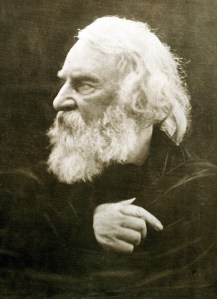
The tide rises, the tide falls,
The twilight darkens, the curlew calls;
Along the sea-sands damp and brown
The traveler hastens toward the town,
And the tide rises, the tide falls.
Darkness settles on roofs and walls,
But the sea, the sea in darkness calls;
The little waves, with their soft, white hands
Efface the footprints in the sands,
And the tide rises, the tide falls.
The morning breaks; the steeds in their stalls
Stamp and neigh, as the hostler calls;
The day returns, but nevermore
Returns the traveler to the shore.
And the tide rises, the tide falls.
We present this work in honor of the poet’s 200th birthday.
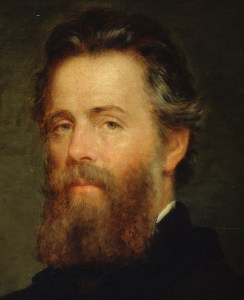
Skimming lightly, wheeling still,
The swallows fly low
Over the field in clouded days,
The forest-field of Shiloh—
Over the field where April rain
Solaced the parched ones stretched in pain
Through the pause of night
That followed the Sunday fight
Around the church of Shiloh—
The church so lone, the log-built one,
That echoed to many a parting groan
And natural prayer
Of dying foemen mingled there—
Foemen at morn, but friends at eve—
Fame or country least their care:
(What like a bullet can undeceive!)
But now they lie low,
While over them the swallows skim,
And all is hushed at Shiloh.
We present this work in honor of the poet’s 175th birthday.
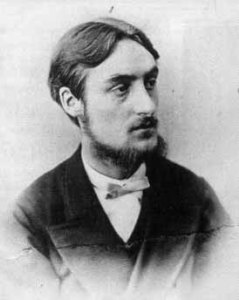
Glory be to God for dappled things—
For skies of couple-colour as a brinded cow;
For rose-moles all in stipple upon trout that swim;
Fresh-firecoal chestnut-falls; finches’ wings;
Landscape plotted and pieced—fold, fallow, and plough;
And all trades, their gear and tackle and trim.
All things counter, original, spare, strange;
Whatever is fickle, freckled (who knows how?)
With swift, slow; sweet, sour; adazzle, dim;
He fathers-forth whose beauty is past change:
Praise Him.
We present this work in honor of the poet’s 235th birthday.

While honouring the grape’s ruby nectar,
All sportingly, laughingly gay;
We determined — I, Silvia, and Hector,
To drive old dame Wisdom away.
“O my children, take care,” said the beldame,
“Attend to these counsels of mine:
Get not tipsy! for danger is seldom
Remote from the goblet of wine.”
“With thee in his company, no man
Can err,” said our wag with a wink;
“But come, thou good-natured old woman,
There’s a drop in the goblet — and drink!”
She frowned — but her scruples soon twisting,
Consented: — and smilingly said:
“So polite — there’s indeed no resisting,
For Wisdom was never ill-bred.”
She drank but continued her teaching:
“Let the wise from indulgence refrain;”
And never gave over her preaching,
But to say, “Fill the goblet again.”
And she drank, and she totter’d, but still she
Was talking and shaking her head:
Muttered “temperance” – “prudence” –
until she Was carried by Love to bed.
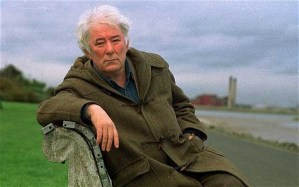
The pockets of our greatcoats full of barley…
No kitchens on the run, no striking camp…
We moved quick and sudden in our own country.
The priest lay behind ditches with the tramp.
A people hardly marching… on the hike…
We found new tactics happening each day:
We’d cut through reins and rider with the pike
And stampede cattle into infantry,
Then retreat through hedges where cavalry must be thrown.
Until… on Vinegar Hill… the final conclave.
Terraced thousands died, shaking scythes at cannon.
The hillside blushed, soaked in our broken wave.
They buried us without shroud or coffin
And in August… the barley grew up out of our grave.
 Poets Corner