The first tree I ever made love to
Took me in its branches with tender care
It hugged me until I could hardly breathe
– Your mother’s milke was not so sweet –
It said in a low rustle after we had finished
I woke up astonished at the clarity of my thought
Exhilarated by a strange feeling of relief
The tree had become a woman
Standing at the foot of my bed
Leafing me with gentle strokes
Pushing her roots over my body
Help Help I cried unable to move as in a nightmare
And then she fell over me
Trying to suck the blood out of my breast
Trying to lap up my body out of a tin plate
Placed in front of a dog’s kennel
I swam desperately trying to get out of reach
Her tongue was getting closer and closer
When a strong breath blew me off the ledge of the plate
I started to fall towards the ground
Which turned out to be her lips
While layers and layers of flesh went past me
And I could read their different shades of meaning
As if they had been the lines of a text
O young Lochinvar is come out of the west,
Through all the wide Border his steed was the best;
And save his good broadsword he weapons had none,
He rode all unarm’d, and he rode all alone.
So faithful in love, and so dauntless in war,
There never was knight like the young Lochinvar.
He staid not for brake, and he stopp’d not for stone,
He swam the Eske river where ford there was none;
But ere he alighted at Netherby gate,
The bride had consented, the gallant came late:
For a laggard in love, and a dastard in war,
Was to wed the fair Ellen of brave Lochinvar.
So boldly he enter’d the Netherby Hall,
Among bride’s-men, and kinsmen, and brothers and all:
Then spoke the bride’s father, his hand on his sword,
(For the poor craven bridegroom said never a word,)
“O come ye in peace here, or come ye in war,
Or to dance at our bridal, young Lord Lochinvar?”
“I long woo’d your daughter, my suit you denied; —
Love swells like the Solway, but ebbs like its tide —
And now I am come, with this lost love of mine,
To lead but one measure, drink one cup of wine.
There are maidens in Scotland more lovely by far,
That would gladly be bride to the young Lochinvar.”
The bride kiss’d the goblet: the knight took it up,
He quaff’d off the wine, and he threw down the cup.
She look’d down to blush, and she look’d up to sigh,
With a smile on her lips and a tear in her eye.
He took her soft hand, ere her mother could bar, —
“Now tread we a measure!” said young Lochinvar.
So stately his form, and so lovely her face,
That never a hall such a gailiard did grace;
While her mother did fret, and her father did fume
And the bridegroom stood dangling his bonnet and plume;
And the bride-maidens whisper’d, “‘twere better by far
To have match’d our fair cousin with young Lochinvar.”
One touch to her hand, and one word in her ear,
When they reach’d the hall-door, and the charger stood near;
So light to the croupe the fair lady he swung,
So light to the saddle before her he sprung!
“She is won! we are gone, over bank, bush, and scaur;
They’ll have fleet steeds that follow,” quoth young Lochinvar.
There was mounting ‘mong Graemes of the Netherby clan;
Forsters, Fenwicks, and Musgraves, they rode and they ran:
There was racing and chasing on Cannobie Lee,
But the lost bride of Netherby ne’er did they see.
So daring in love, and so dauntless in war,
Have ye e’er heard of gallant like young Lochinvar?
It’s no go the merrygoround, it’s no go the rickshaw,
All we want is a limousine and a ticket for the peepshow.
Their knickers are made of crepe-de-chine, their shoes are made of python,
Their halls are lined with tiger rugs and their walls with head of bison.
John MacDonald found a corpse, put it under the sofa,
Waited till it came to life and hit it with a poker,
Sold its eyes for souvenirs, sold its blood for whiskey,
Kept its bones for dumbbells to use when he was fifty.
It’s no go the Yogi-man, it’s no go Blavatsky,
All we want is a bank balance and a bit of skirt in a taxi.
Annie MacDougall went to milk, caught her foot in the heather,
Woke to hear a dance record playing of Old Vienna.
It’s no go your maidenheads, it’s no go your culture,
All we want is a Dunlop tire and the devil mend the puncture.
The Laird o’ Phelps spent Hogmanay declaring he was sober,
Counted his feet to prove the fact and found he had one foot over.
Mrs. Carmichael had her fifth, looked at the job with repulsion,
Said to the midwife “Take it away; I’m through with overproduction.”
It’s no go the gossip column, it’s no go the Ceilidh,
All we want is a mother’s help and a sugar-stick for the baby.
Willie Murray cut his thumb, couldn’t count the damage,
Took the hide of an Ayrshire cow and used it for a bandage.
His brother caught three hundred cran when the seas were lavish,
Threw the bleeders back in the sea and went upon the parish.
It’s no go the Herring Board, it’s no go the Bible,
All we want is a packet of fags when our hands are idle.
It’s no go the picture palace, it’s no go the stadium,
It’s no go the country cot with a pot of pink geraniums,
It’s no go the Government grants, it’s no go the elections,
Sit on your arse for fifty years and hang your hat on a pension.
It’s no go my honey love, it’s no go my poppet;
Work your hands from day to day, the winds will blow the profit.
The glass is falling hour by hour, the glass will fall forever,
But if you break the bloody glass you won’t hold up the weather.
Cool glass, when leaning forehead against window.
Late-night lights go out, leaving us even lonelier.
Spiderwebs woven by wires over rooftops.
Hollow trot of passing nags touches us for no reason.
What does the howl of these cats in heat call to mind,
and what can the scraps of paper be plotting
as they slither onto empty patios?
The time of night when old furniture seizes the chance to shed its lies,
when pipes make strangulated cries, as though suffocating inside the walls.
Now and then we think, when flipping the electric light switch,
of the fright the shadows must feel, and we’d like to warn them
so they have time to curl up in the corners.
And now and then there is something sinister
about the telephone-pole crosses over the rooftops,
and one wants to slink along the walls like a cat or a thief.
Nights when we wish for a hand to caress our lower back,
when we suddenly realize that no tenderness compares
to stroking something as it sleeps.
Silence!—voiceless cricket that hops in our ear.
Leaky faucet song!—the only cricket that fits the city.
In Rome at the New Year it is the custom to throw old things into the street.
Rome rattles and shakes
like a runaway breakdown truck.
All over Rome and round about
the New Year’s coming in!
Like Mills bombs, bottles
dropped from windowsills.
crash all over the place,
and what price that tough
shoving a bathtub onto a balcony?
Up on the Piazza di Spagna,
spinning like a flying saucer,
a husband is flung from his nuptial bed:
he’s obsolete and all but dead!
They’ve cornered a naked man in a bar,
‘Damn you squares!’, he bawls,
‘I need a change of suit:
last year’s is out of date’.
Dear town, we shall flounder and drown
In your cast-offs and metamorphoses;
your ancient asphalted roadways
gleam like the sloughed skins of pythons.
All the times you have shuffled them off,
but the speedometers show they’re still too slow
for Roman girls on Vespas!
So what next do you have in store for us?
The human race with roars and guffaws
is ridding itself of its rubbish,
do we all need overhauls?
Like Time itself we approach our hour
and stand, forgetting petty chores,
fully absorbed now by the future.
Do we regret what we’re discarding?
A reindeer’s dam, just after fawning,
looks loving and a little overcome.
Maybe the New Year will be rough,
with a few good days for flying in it?
Don’t worry: it won’t be the end of the world
– and the more fun we’ll have saying goodbye to it.
We fly through the air like apples off branches.
This fuss is already rather a bore,
though later, at least, I have something to live for:
– towards the middle of the windy day,
in her lopsided winter villa she’ll say
(once she’s gallopped through that thriller)
that she’s cold when I’m not with her,
she’s cold without me is what she’ll say…
And past other worlds
into darkness, deadpan as a croupier,
our pale planet whirls –
cooped in its shell like an embryo bird.
It’s hatching out now, look!
What to become? A warbler?
Or a black thing, a baby rook
blasted off the wing by atomic warheads?
I only hope the weather keeps fine
for all these darling creatures…
Over Rome – and all the world what’s more –
the New Year’s coming in…
…with tangerines and amorous passes,
and right till dawn the women’s bodies
– like electric bulbs in lampshades –
glowing through their dresses.
once the poem satiates itself on the ivory honey of tarantulas
& the albumen of a bogus star
exploding hopelessly under the coke of my assemblies
once the berbers post-total-fantasia
fling what calabashes they have into the void of rifles
a conspiracy of eagles hatched by the true figure
of discovery & joy
will display my humid fever like april is
milky from almond & torrent
once the widowers stir the ashy heart of the minaret
once the children embrace scorpions by the hook
the prose of exile will have tempered such that it suffices
to snip its umbilical cord from this anxiety of mine
& sever the oars slapping the dorsal spine of my fatigue
to its delirious point
I’m laying you out
little nostalgia-worlds
in the shipwrecking gaze of the dead
still fit
to recite from the chapters of audacious crime
the arachnids’ closing statement
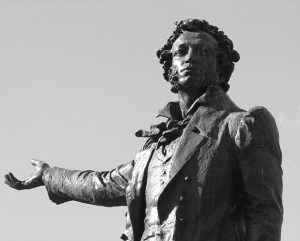
In honor of the Russian holiday, Victory Day, we present this work by Russia’s most legendary poet.
Alexander Pushkin Russian 1799 – 1837
I loved you once: perhaps that love has yet
To die down thoroughly within my soul;
But let it not dismay you any longer;
I have no wish to cause you any sorrow.
I loved you wordlessly, without a hope,
By shyness tortured, or by jealousy.
I loved you with such tenderness and candor
And pray God grants you to be loved that way again.
“Where is the friend’s house?” asked the horseman just at dawn.
The Heavens paused.
A wayfarer took the bright branch from his lips,
conferred it on the darkness of the sands,
pointed with his finger to a poplar tree and said,
“Just before that tree
there is a garden path greener than God’s dreams.
In it there is love as wide as the blue wings of true friendship.
You go on to the end of the path that takes up again
just beyond maturity,
then turn toward the flower of loneliness.
Two steps before the flower,
stop at the eternal fountain of earthly myth.
There a transparent terror will seize you,
and in the sincerity of the streaming heavens
you will hear a rustling.
High up in a pine tree,
you will see a child
who will lift a chick out of a nest of light.
Ask him,
‘Where is the friend’s house?’”
 Poets Corner