We present this work in honor of the 130th anniversary of the poet’s death.
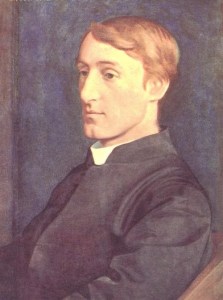
Gerard Manley Hopkins English 1844 – 1889
As kingfishers catch fire, dragonflies draw flame;
As tumbled over rim in roundy wells
Stones ring; like each tucked string tells, each hung bell’s
Bow swung finds tongue to fling out broad its name;
Each mortal thing does one thing and the same:
Deals out that being indoors each one dwells;
Selves — goes itself; myself it speaks and spells,
Crying What I do is me: for that I came.
I say more: the just man justices;
Keeps grace: that keeps all his goings graces;
Acts in God’s eye what in God’s eye he is —
Christ. For Christ plays in ten thousand places,
Lovely in limbs, and lovely in eyes not his
To the Father through the features of men’s faces.
– No, no!
and the dirtyneck boy starts crying and running
without getting away, in a moment, on the streets.
His hands,
he’s got something in his hands!
he doesn’t know what it is, but he runs to the dawn
With his hidden prize.
Endlessly beforehand, we know what his trophy is;
something ignored, that the soul keeps awake in us.
We almost start to glitter inside his gold
with extravagant nakedness…
– No, no!
and the dirtyneck boy starts crying and running
without getting away, in a moment, on the street.
The arm is strong, it could easily grab him…
The heart, also a beggar, lets him go.
If instead of being hanged by the neck
you’re thrown inside
for not giving up hope
in the world, your country, your people,
if you do ten or fifteen years
apart from the time you have left,
you won’t say,
“Better I had swung from the end of a rope
like a flag” —
You’ll put your foot down and live.
It may not be a pleasure exactly,
but it’s your solemn duty
to live one more day
to spite the enemy.
Part of you may live alone inside,
like a tone at the bottom of a well.
But the other part
must be so caught up
in the flurry of the world
that you shiver there inside
when outside, at forty days’ distance, a leaf moves.
To wait for letters inside,
to sing sad songs,
or to lie awake all night staring at the ceiling
is sweet but dangerous.
Look at your face from shave to shave,
forget your age,
watch out for lice
and for spring nights,
and always remember
to eat every last piece of bread—
also, don’t forget to laugh heartily.
And who knows,
the woman you love may stop loving you.
Don’t say it’s no big thing:
it’s like the snapping of a green branch
to the man inside.
To think of roses and gardens inside is bad,
to think of seas and mountains is good.
Read and write without rest,
and I also advise weaving
and making mirrors.
I mean, it’s not that you can’t pass
ten or fifteen years inside
and more —
you can,
as long as the jewel
on the left side of your chest doesn’t lose it’s luster!
We present this work in honor of Western Australia Day.
Patrick White Australian 1912 – 1990
I saw a ploughman against the sky,
The wind of the sea in his horses’ manes,
And the share it was shod with gold;
Down to the sea, on the curve of the hill.
A foam of gulls in the furrow.
The ploughman walking behind his plough.
I heard the cry of the wave in the throats of the gulls,
Far off cry like the voice from a shell,
Yet beating down on me out of the trees,
Out of the net of the leafless trees.
I watched the ploughman stooping behind his plough.
As if Tune crouched on his shoulders there on the hill;
As if he had ploughed all yesterday, when the ships
Sailed fleecy into the harbour down below;
As if he had ploughed all the day before
When men were bright with steel in the valley.
With steel as bright as a winter sky
When the sun ebbs under the rim of the sea;
Ploughing, ploughing, ploughing the bones of
the centuries into the earth:
All pain yielded up in the sigh of the gulls;
Sorrow hid beneath poppy and dock,
To be soothed by the tremulous flame of the corn in spring.
The ploughman was singing, yet wordless his song,
For words are forgotten while thrushes’ notes linger
And music of water is graven in stone.
All is forgotten: the tramping of soldiers;
And proud white list of the clippers from China;
Only the ploughman remains as he follows
The plumed and glistening path of his furrow
Over the field that is strown with gulls.
dirty and ugly they saw me there goes an empty head they said
in fact I am more like an open book there’s much useful stuff
inside this head
o my heart I burn you and if you want I will do more
o my heart you shame me because you like who doesn’t
like you.
neither think nor search too much don’t always be
despondent
the planets are not fixed and life’s not eternal
don’t play with your best friend’s feelings & if people insult
him, ease his mind
who loves you, love him more but if he betrays you, don’t ever
be his friend again
all I’ve had in life is one goat but I’ve written beautiful
quatrains
many are fulfilled through God’s favor yet claim those favors as
their own labors
travel and you’ll get to know people and owe obedience to the
noble
the fathead with the pot-belly sell him for a dime
my heart’s between a hammer & an anvil & that damned
blacksmith has no pity
he keeps hammering & when it cools he kindles the fire
with his bellows
my weak heart can’t bear any pain and by God you are
barbarians
you supported me when I was strong and let me down
when I grew weak
o you who sows the good grain by grain o you who sows
the bad lot by lot
the good multiplies and rises the bad withers and wastes
away
don’t think of this time’s tightness see how wide time is
in God
difficulties wipe out the weak but men wipe out difficulties
I suggest to you devourer of sheep heads throw those
bones in a well
laugh & play with the people but before all shut your
mouth
silence is abundant gold and words destroy good
ambiance
say nothing if you see something and if they ask say
no, no
o friend, be patient hide your burden
sleep naked on thorns wait for a brighter day
the good old days are gone hard ones are here
who dares speak the truth will have his head cut off
don’t get in the saddle before you bridle and tie strong
knots
think twice before you speak or you’ll live to regret it
I made snow into a bed & covered myself with the wind
I made the moon into a lamp & went to sleep in the
starry night
misery should be hidden away & covered under a veil
cover the wound with the skin & the wound will soon heal
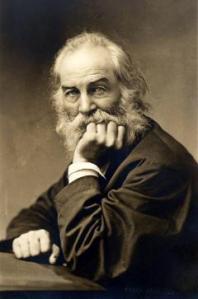
We present this work in honor of the poet’s 200th birthday.
Walt Whitman American 1819 – 1892
O Captain! my Captain! our fearful trip is done;
The ship has weather’d every rack, the prize we sought is won;
The port is near, the bells I hear, the people all exulting,
While follow eyes the steady keel, the vessel grim and daring:
But O heart! heart! heart!
O the bleeding drops of red,
Where on the deck my Captain lies,
Fallen cold and dead.
O Captain! my Captain! rise up and hear the bells;
Rise up—for you the flag is flung–for you the bugle trills;
For you bouquets and ribbon’d wreaths—for you the shores a-crowding;
For you they call, the swaying mass, their eager faces turning;
Here Captain! dear father!
This arm beneath your head;
It is some dream that on the deck,
You’ve fallen cold and dead.
My Captain does not answer, his lips are pale and still;
My father does not feel my arm, he has no pulse nor will;
The ship is anchor’d safe and sound, its voyage closed and done;
From fearful trip, the victor ship, comes in with object won;
Exult, O shores, and ring, O bells!
But I, with mournful tread,
Walk the deck my Captain lies,
Fallen cold and dead.
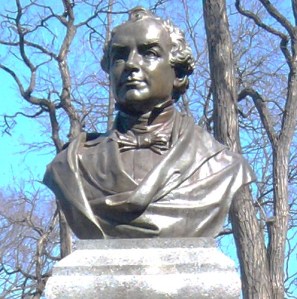
We present this work in honor of the poet’s 240th birthday.
Thomas Moore Irish 1779 – 1852
My banks are all furnished with rags,
So thick, even Freddy can’t thin ‘em;
I’ve torn up my old money-bags,
Having little or nought to put in ‘em.
My tradesman are smashing by dozens,
But this is all nothing, they say;
For bankrupts, since Adam, are cousins,
So, it’s all in the family way.
My Debt not a penny takes from me,
As sages the matter explain; —
Bob owes it to Tom and then Tommy
Just owes it to Bob back again.
Since all have thus taken to owing,
There’s nobody left that can pay;
And this is the way to keep going, —
All quite in the family way.
My senators vote away millions,
To put in Prosperity’s budget;
And though it were billions or trillions,
The generous rogues wouldn’t grudge it.
‘Tis all but a family hop,
‘Twas Pitt began dancing the hay;
Hands round! — why the deuce should we stop?
‘Tis all in the family way.
My labourers used to eat mutton,
As any great man of the State does;
And now the poor devils are put on
Small rations of tea and potatoes.
But cheer up John, Sawney and Paddy,
The King is your father, they say;
So ev’n if you starve for your Daddy,
‘Tis all in the family way.
My rich manufacturers tumble,
My poor ones have nothing to chew;
And, even if themselves do not grumble,
Their stomachs undoubtedly do.
But coolly to fast en famille,
Is as good for the soul as to pray;
And famine itself is genteel,
When one starves in a family way.
I have found out a secret for Freddy,
A secret for next Budget day;
Though, perhaps he may know it already,
As he, too, ‘s a sage in his way.
When next for the Treasury scene he
Announces “the Devil to pay”,
Let him write on the bills, “Nota bene,
‘Tis all in the family way.”
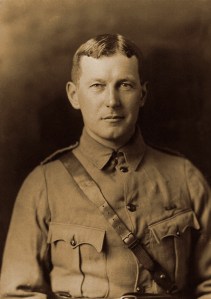
In Flanders fields the poppies blow
Between the crosses, row on row,
That mark our place; and in the sky
The larks, still bravely singing, fly
Scarce heard amid the guns below.
We are the Dead. Short days ago
We lived, felt dawn, saw sunset glow,
Loved and were loved, and now we lie,
In Flanders fields.
Take up our quarrel with the foe:
To you from failing hands we throw
The torch; be yours to hold it high.
If ye break faith with us who die
We shall not sleep, though poppies grow
In Flanders fields.
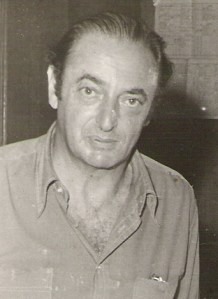
In honor of the Argentine holiday of May Day Revolution, we present this work by one of Argentina’s most delightfully subversive poets.
Humberto Costantini Argentine 1924 – 1987
Dear boss,
I’m writing to inform you that,
having now completed 20 years of continuous work in this office,
it is imperative, if I am to proceed with this task,
that you send me, at your very earliest convenience,
the items I list below:
A grey sky, some low clouds and an autumn day, if possible.
And a lot of very old trees…
casuarinas, as dark as time.
Would it be too much to ask for some poplars as well?
And dampness,
a slow drizzle – and earth,
definitely earth,
and the smell of earth and autumn and trees.
You could perhaps omit dry leaves,
but not the heart on fire,
nor the blood full of birdsong;
and don’t leave out vertigo either
or the blond girl at my side with all her tenderness,
or the blood filling with birds…


 Poets Corner