In honor of Mihavir Jayanti, we present this work by one of India’s greatest 20th century poets.
Dilip Chitre Indian 1938 – 2009
My father travels on the late evening train
Standing among silent commuters in the yellow light
Suburbs slide past his unseeing eyes
His shirt and pants are soggy and his black raincoat
Stained with mud and his bag stuffed with books
Is falling apart. His eyes dimmed by age
fade homeward through the humid monsoon night.
Now I can see him getting off the train
Like a word dropped from a long sentence.
He hurries across the length of the grey platform,
Crosses the railway line, enters the lane,
His chappals are sticky with mud, but he hurries onward.
Home again, I see him drinking weak tea,
Eating a stale chapati, reading a book.
He goes into the toilet to contemplate
Man’s estrangement from a man-made world.
Coming out he trembles at the sink,
The cold water running over his brown hands,
A few droplets cling to the greying hairs on his wrists.
His sullen children have often refused to share
Jokes and secrets with him. He will now go to sleep
Listening to the static on the radio, dreaming
Of his ancestors and grandchildren, thinking
Of nomads entering a subcontinent through a narrow pass.
The angels the angels in the sky
One’s dressed as an officer
One’s dressed as a chef today
And the others sing
Fine sky-coloured officer
Sweet Spring when Christmas is long gone
Will deck you with a lovely sun
A lovely sun
The chef plucks geese
Ah! Snowfalls hiss
Fall and how I miss
My beloved in my arms
O, whom he misgives into singing bird is wrong
I didn’t think anyone carry this stingy feature for long
If all peoples’ ears would listen to its sound
Its sound will be not lessened or multiplied
If not I took care form thy meteor would burn me
I should eavesdrop to distant place probably
If Zaryab the musical was alive then he heard me
He would be dissolved at jealousy and died sadly
Don’t be grudger upon my hearing tiring to copy
It is a sound can play instead of soul in the body
Yet wine I don’t drink it now and formerly
I don’t come to thee unless I am satisfied totally
If I forgive and ignore your coldness,
How can I be free of the memory of you.
Your gaze is dear. The heart has no price.
Tell me to forget, have pity on me,
Or tell me to come.
Come drink this glass with me.
Snow and silence rest on the coast
The waves are motionless on the sand
And the wind – an unmanned boat.
Remnants of an oar
And a spider.
Who can ignite joy in my eyes?
Who can awaken the giant?
Who dies?
The smell of death in the garden
Mocks the seasons
And you, my girlfriend,
A choke and a tear in the virgin’s eye.
Sounds of footsteps on the debris
Search for the truth
For a dagger, for a protective arm.
Deep down in my wounds
The eagle’s feathers were
A voice and a silence
That yearn for the beats of drums
For a shower of rain
To water its palate,
And the (wrestling) ring
Is a soft cloud
That hovers around the horses’ missteps.
Go back with my remains
My blood did not anticipate its course.
Who awaits the dawn and is impatient to arrive?
Who has clung to the rock of my speculations?
Who has stretched his beak out
Towards my eyes?
Oh robber of the torch
There is clamour in silence.
Pick up the daisies of light
In tenacious obscurity.
We sought silence in caves
For impurities cannot be purged by words
Let’s dive beneath waves and rocks.
Surely there is a flicker of light at the bottom
Turn it into a spark
That rescues the wind
From the chains of silence
And teaches humanity how to die!
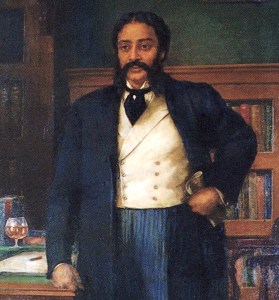
In honor of Ugadi, we present this work by one of the great 19th century Indian poets.
Michael Madhususdan Dutt Indian 1824 – 1873
I am not rich, nay, nor the future heir
To sparkling gold or silver heaped on store;
There is no marble blushing on my floor
With thousand varied dies:—no gilded chair,
No cushions, carpets that by riches are
Brought from the Persian land, or Turkish shore;
There is no menial waiting at my door
Attentive to the knell: and all things rare,
Born in remotest regions, that shine in
And grace the rich-man’s hall, are wanting here.
These are not things that by blind Fate have been
Allotted ever to the poor man’s share:
These are not things, these eyes have ever seen,
Tho’ their proud names have sounded in this ear!
I was annoyed with myself for
Saying I loved her, because
What I wanted, then, was
Less, or more.
And it was no fun
Putting her head in a whirl;
She was such a quiet girl;
It’s not done.
Anyhow, I didn’t do it;
I just kissed her, and then
Tried not to see her again,
Feeling rather a brute.
Perhaps I should have gone
Through with it; she’d have had
One sin, when she was old and sad,
To congratulate herself on.
But I remember, I thought at the time:
You’d better not;
They hang on to what they’ve got
Like birdlime.
You eat the fruit and sing;
When you’ve had enough,
They talk all about love,
And you’re caught there, twittering;
Afraid to look her in the face,
Afraid of what people may say,
Afraid of her relations all day,
And at night, of an imagined disgrace;
Or you have her tagged on to you
For the term of your natural life,
And have to say, “This is my wife;
This is the best I could do”;
And somehow in the end you find
She sits like an over-ripe tomato,
Or walks like a scarecrow,
Because of her beautiful mind:
Like something or other; like a red crystal
Dropped into the pellucid cup
Of a man’s life; time melts it up,
And the lying purple permeates all.
I have seen how many a match
Has gone this way; how an honest man
With a clear mind, can
Turn slowly to a lovely purple patch.
Sometimes I wish I could myself; but
I should not easily come to heel,
I feel, and I feel
I should feel I was getting into a rut.
So perhaps it’s all in the best. interest
Of girls in general; for their part
They take heart;
Indeed, they seem singularly unimpressed
While I sit wearily in my sitting room
And watch the virtuous hands of the clock
Turning the afternoon into a lock
On shadows coinciding with my gloom.
It’s the way I’m made,
Probably. God knows.
As the twig’s bent, it grows,
I’m afraid.


 Poets Corner