Up the airy mountain,
Down the rushy glen,
We daren’t go a-hunting
For fear of little men;
Wee folk, good folk,
Trooping all together;
Green jacket, red cap,
And white owl’s feather!
Down along the rocky shore
Some make their home,
They live on crispy pancakes
Of yellow tide-foam;
Some in the reeds
Of the black mountain lake,
With frogs for their watch-dogs,
All night awake.
High on the hill-top
The old King sits;
He is now so old and gray
He’s nigh lost his wits.
With a bridge of white mist
Columbkill he crosses,
On his stately journeys
From Slieveleague to Rosses;
Or going up with music
On cold starry nights
To sup with the Queen
Of the gay Northern Lights.
They stole little Bridget
For seven years long;
When she came down again
Her friends were all gone.
They took her lightly back,
Between the night and morrow,
They thought that she was fast asleep,
But she was dead with sorrow.
They have kept her ever since
Deep within the lake,
On a bed of flag-leaves,
Watching till she wake.
By the craggy hill-side,
Through the mosses bare,
They have planted thorn-trees
For pleasure here and there.
If any man so daring
As dig them up in spite,
He shall find their sharpest thorns
In his bed at night.
Up the airy mountain,
Down the rushy glen,
We daren’t go a-hunting
For fear of little men;
Wee folk, good folk,
Trooping all together;
Green jacket, red cap,
And white owl’s feather!
The breeze fair aft, all sails on high,
Ten guns on each side mounted seen,
She does not cut the sea, but fly,
A swiftly sailing brigantine;
A pirate bark, the “Dreaded” name,
For her surpassing boldness famed,
On every sea well-known and shore,
From side to side their boundaries o’er.
The moon in streaks the waves illumes
Hoarse groans the wind the rigging through;
In gentle motion raised assumes
The sea a silvery shade with blue;
Whilst singing gaily on the poop
The pirate Captain, in a group,
Sees Europe here, there Asia lies,
And Stamboul in the front arise.
“Sail on, my swift one! nothing fear;
Nor calm, nor storm, nor foeman’s force,
Shall make thee yield in thy career
Or turn thee from thy course.
Despite the English cruisers fleet
We have full twenty prizes made;
And see their flags beneath my feet
A hundred nations laid. My treasure is my gallant bark, My only God is liberty; My law is might, the wind my mark, My country is the sea.
“There blindly kings fierce wars maintain,
For palms of land, when here I hold
As mine, whose power no laws restrain,
Whate’er the seas infold.
Nor is there shore around whate’er,
Or banner proud, but of my might
Is taught the valorous proofs to bear,
And made to feel my right. My treasure is my gallant bark, My only God is liberty; My law is might, the wind my mark, My country is the sea.
“Look when a ship our signals ring,
Full sail to fly how quick she’s veered!
For of the sea I am the king,
My fury’s to be feared;
But equally with all I share
Whate’er the wealth we take supplies;
I only seek the matchless fair,
My portion of the prize. My treasure is my gallant bark, My only God is liberty; My law is might, the wind my mark, My country is the sea.
“I am condemned to die! — I laugh;
For, if my fates are kindly sped,
My doomer from his own ship’s staff
Perhaps I’ll hang instead.
And if I fall, why what is life?
For lost I gave it then as due,
When from slavery’s yoke in strife
A rover! I withdrew. My treasure is my gallant bark, My only God is liberty; My law is might, the wind my mark, My country is the sea.
“My music is the Northwind’s roar;
The noise when round the cable runs,
The bellowings of the Black Sea’s shore,
And rolling of my guns.
And as the thunders loudly sound,
And furious the tempests rave,
I calmly rest in sleep profound,
So rocked upon the wave. My treasure is my gallant bark, My only God is liberty; My law is might, the wind my mark, My country is the sea.
We present this work in honor of the poet’s 90th birthday.
A.K. Ramanujan Indian 1929 – 1993
The Striders
And search
For certain thin-
Stemmed, bubble-eyed water bugs.
See them perch
On dry capillary legs
Weightless
On the ripple skin
Of a stream
Not only prophets
Walk in water.
The bug sits
On a landslide of lights
And drowns eye
Deep Into its tiny strip
Of sky.
In England once there lived a big
And wonderfully clever pig.
To everybody it was plain
That Piggy had a massive brain.
He worked out sums inside his head,
There was no book he hadn’t read,
He knew what made an airplane fly,
He knew how engines worked and why.
He knew all this, but in the end
One question drove him round the bend:
He simply couldn’t puzzle out
What LIFE was really all about.
What was the reason for his birth?
Why was he placed upon this earth?
His giant brain went round and round.
Alas, no answer could be found,
Till suddenly one wondrous night,
All in a flash, he saw the light.
He jumped up like a ballet dancer
And yelled, “By gum, I’ve got the answer!”
“They want my bacon slice by slice
“To sell at a tremendous price!
“They want my tender juicy chops
“To put in all the butchers’ shops!
“They want my pork to make a roast
“And that’s the part’ll cost the most!
“They want my sausages in strings!
“They even want my chitterlings!
“The butcher’s shop! The carving knife!
“That is the reason for my life!”
Such thoughts as these are not designed
To give a pig great peace of mind.
Next morning, in comes Farmer Bland,
A pail of pigswill in his hand,
And Piggy with a mighty roar,
Bashes the farmer to the floor . . .
Now comes the rather grizzly bit
So let’s not make too much of it,
Except that you must understand
That Piggy did eat Farmer Bland,
He ate him up from head to toe,
Chewing the pieces nice and slow.
It took an hour to reach the feet,
Because there was so much to eat,
And when he’d finished, Pig, of course,
Felt absolutely no remorse.
Slowly he scratched his brainy head
And with a little smile, he said,
“I had a fairly powerful hunch
“That he might have me for his lunch.
“And so, because I feared the worst,
“I thought I’d better eat him first.”
Advancing years may bring about
A rather sweet nostalgia
In spite of rheumatism and gout
And, certainly, neuralgia.
And so, when we have churned our way
Through luncheon and a matinée,
We gratefully to bed retire
To rest our aching, creaking vertebrae
And have a little something on a tray.
Some ageing ladies with a groan
Renounce all beauty lotions,
They dab their brows with eau-de-Cologne
And turn to their devotions,
We face the process of decay
Attired in a négligé
And with hot bottles at our toes
We cosily in bed repose
Enjoying, in a rather languid way,
A little ‘eggy’ something on a tray.
Advancing years that many dread
Still have their compensations,
We turn when youth and passion have fled
To more sedate sensations,
And when we’ve fought our weary way
Through some exhausting social day
We thankfully to bed retire
With pleasant book and crackling fire
And, like Salome in a bygone day,
Enjoy a little something on a tray.
When weary from the fray
Something on a tray
Sends weariness away,
Something on a tray,
Thank God, thank God we say,
For something on a tray.
Ah, would to God, dear country maid,
I had been swallowed by the main
So in my senses to remain
And not to lunacy betrayed
For love of you. The sea could harm me
Drowned between silver waves and blue
That roll forever out of view―
But with fierce fire it could not char me.
You share the quality that flashes
In the great sun, like whom you show,
Though seeming cold and white as snow,
Yet you can burn a man to ashes.
If a daughter you have, she’s the plague of your life,
No peace shall you know, tho’ you’ve buried your wife,
At twenty she mocks at the duty you taught her,
O, what a plague is an obstinate daughter.
Sighing and whining,
Dying and pining,
O, what a plague is an obstinate daughter.
When scarce in their teens, they have wit to perplex us,
With letters and lovers for ever they vex us,
While each still rejects the fair suitor you’ve brought her,
O, what a plague is an obstinate daughter.
Wrangling and jangling,
Flouting and pouting,
O, what a plague is an obstinate daughter.
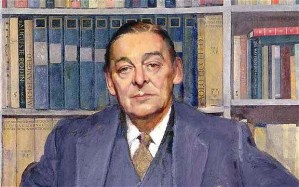
In honor of Ash Wednesday, we present this work that bears the title.
T.S. Eliot American 1888 – 1965
Because I do not hope to turn again
Because I do not hope
Because I do not hope to turn
Desiring this man’s gift and that man’s scope
I no longer strive to strive towards such things
(Why should the agèd eagle stretch its wings?)
Why should I mourn
The vanished power of the usual reign?
Because I do not hope to know
The infirm glory of the positive hour
Because I do not think
Because I know I shall not know
The one veritable transitory power
Because I cannot drink
There, where trees flower, and springs flow, for there is
nothing again
Because I know that time is always time
And place is always and only place
And what is actual is actual only for one time
And only for one place
I rejoice that things are as they are and
I renounce the blessèd face
And renounce the voice
Because I cannot hope to turn again
Consequently I rejoice, having to construct something
Upon which to rejoice
And pray to God to have mercy upon us
And pray that I may forget
These matters that with myself I too much discuss
Too much explain
Because I do not hope to turn again
Let these words answer
For what is done, not to be done again
May the judgement not be too heavy upon us
Because these wings are no longer wings to fly
But merely vans to beat the air
The air which is now thoroughly small and dry
Smaller and dryer than the will
Teach us to care and not to care Teach us to sit still.
Pray for us sinners now and at the hour of our death
Pray for us now and at the hour of our death.
II
Lady, three white leopards sat under a juniper-tree
In the cool of the day, having fed to sateity
On my legs my heart my liver and that which had been
contained
In the hollow round of my skull. And God said
Shall these bones live? shall these
Bones live? And that which had been contained
In the bones (which were already dry) said chirping:
Because of the goodness of this Lady
And because of her loveliness, and because
She honours the Virgin in meditation,
We shine with brightness. And I who am here dissembled
Proffer my deeds to oblivion, and my love
To the posterity of the desert and the fruit of the gourd.
It is this which recovers
My guts the strings of my eyes and the indigestible portions
Which the leopards reject. The Lady is withdrawn
In a white gown, to contemplation, in a white gown.
Let the whiteness of bones atone to forgetfulness.
There is no life in them. As I am forgotten
And would be forgotten, so I would forget
Thus devoted, concentrated in purpose. And God said
Prophesy to the wind, to the wind only for only
The wind will listen. And the bones sang chirping
With the burden of the grasshopper, saying
Lady of silences
Calm and distressed
Torn and most whole
Rose of memory
Rose of forgetfulness
Exhausted and life-giving
Worried reposeful
The single Rose
Is now the Garden
Where all loves end
Terminate torment
Of love unsatisfied
The greater torment
Of love satisfied
End of the endless
Journey to no end
Conclusion of all that
Is inconclusible
Speech without word and
Word of no speech
Grace to the Mother
For the Garden
Where all love ends.
Under a juniper-tree the bones sang, scattered and shining
We are glad to be scattered, we did little good to each
other,
Under a tree in the cool of day, with the blessing of sand,
Forgetting themselves and each other, united
In the quiet of the desert. This is the land which ye
Shall divide by lot. And neither division nor unity
Matters. This is the land. We have our inheritance.
III
At the first turning of the second stair
I turned and saw below
The same shape twisted on the banister
Under the vapour in the fetid air
Struggling with the devil of the stairs who wears
The deceitul face of hope and of despair.
At the second turning of the second stair
I left them twisting, turning below;
There were no more faces and the stair was dark,
Damp, jaggèd, like an old man’s mouth drivelling, beyond
repair,
Or the toothed gullet of an agèd shark.
At the first turning of the third stair
Was a slotted window bellied like the figs’s fruit
And beyond the hawthorn blossom and a pasture scene
The broadbacked figure drest in blue and green
Enchanted the maytime with an antique flute.
Blown hair is sweet, brown hair over the mouth blown,
Lilac and brown hair;
Distraction, music of the flute, stops and steps of the mind
over the third stair,
Fading, fading; strength beyond hope and despair
Climbing the third stair.
Lord, I am not worthy
Lord, I am not worthy
but speak the word only.
IV
Who walked between the violet and the violet
Who walked between
The various ranks of varied green
Going in white and blue, in Mary’s colour,
Talking of trivial things
In ignorance and knowledge of eternal dolour
Who moved among the others as they walked,
Who then made strong the fountains and made fresh the springs
Made cool the dry rock and made firm the sand
In blue of larkspur, blue of Mary’s colour,
Sovegna vos
Here are the years that walk between, bearing
Away the fiddles and the flutes, restoring
One who moves in the time between sleep and waking, wearing
White light folded, sheathing about her, folded.
The new years walk, restoring
Through a bright cloud of tears, the years, restoring
With a new verse the ancient rhyme. Redeem
The time. Redeem
The unread vision in the higher dream
While jewelled unicorns draw by the gilded hearse.
The silent sister veiled in white and blue
Between the yews, behind the garden god,
Whose flute is breathless, bent her head and signed but spoke
no word
But the fountain sprang up and the bird sang down
Redeem the time, redeem the dream
The token of the word unheard, unspoken
Till the wind shake a thousand whispers from the yew
And after this our exile
V
If the lost word is lost, if the spent word is spent
If the unheard, unspoken
Word is unspoken, unheard;
Still is the unspoken word, the Word unheard,
The Word without a word, the Word within
The world and for the world;
And the light shone in darkness and
Against the Word the unstilled world still whirled
About the centre of the silent Word.
O my people, what have I done unto thee.
Where shall the word be found, where will the word
Resound? Not here, there is not enough silence
Not on the sea or on the islands, not
On the mainland, in the desert or the rain land,
For those who walk in darkness
Both in the day time and in the night time
The right time and the right place are not here
No place of grace for those who avoid the face
No time to rejoice for those who walk among noise and deny
the voice
Will the veiled sister pray for
Those who walk in darkness, who chose thee and oppose thee,
Those who are torn on the horn between season and season,
time and time, between
Hour and hour, word and word, power and power, those who wait
In darkness? Will the veiled sister pray
For children at the gate
Who will not go away and cannot pray:
Pray for those who chose and oppose
O my people, what have I done unto thee.
Will the veiled sister between the slender
Yew trees pray for those who offend her
And are terrified and cannot surrender
And affirm before the world and deny between the rocks
In the last desert before the last blue rocks
The desert in the garden the garden in the desert
Of drouth, spitting from the mouth the withered apple-seed.
O my people.
VI
Although I do not hope to turn again
Although I do not hope
Although I do not hope to turn
Wavering between the profit and the loss
In this brief transit where the dreams cross
The dreamcrossed twilight between birth and dying
(Bless me father) though I do not wish to wish these things
From the wide window towards the granite shore
The white sails still fly seaward, seaward flying
Unbroken wings
And the lost heart stiffens and rejoices
In the lost lilac and the lost sea voices
And the weak spirit quickens to rebel
For the bent golden-rod and the lost sea smell
Quickens to recover
The cry of quail and the whirling plover
And the blind eye creates
The empty forms between the ivory gates
And smell renews the salt savour of the sandy earth
This is the time of tension between dying and birth
The place of solitude where three dreams cross
Between blue rocks
But when the voices shaken from the yew-tree drift away
Let the other yew be shaken and reply.
Blessèd sister, holy mother, spirit of the fountain, spirit
of the garden,
Suffer us not to mock ourselves with falsehood
Teach us to care and not to care
Teach us to sit still
Even among these rocks,
Our peace in His will
And even among these rocks
Sister, mother
And spirit of the river, spirit of the sea,
Suffer me not to be separated
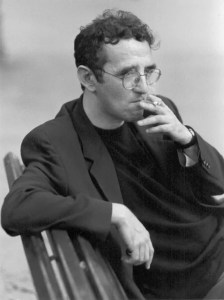
The memory of Lisa descends again
through night’s hole.
A rope, a beam of light
and there it is:
the ideal Mexican village.
Amidst the barbarity, Lisa’s smile,
Lisa’s frozen film,
Lisa’s fridge with the door open
sprinkling a little light on
this disorganized room that I,
now pushing forty,
call Mexico, call Mexico City,
call Roberto Bolaño looking for a pay phone
amidst chaos and beauty
to call his one and only true love.




 Poets Corner