I submitted to the most poisonous stings to suck his lips he swore on the conscience of beehives not to assault the flowers of my scarf Then he unbuttoned my shirt and mingled with me just like a bee falling head on into a glass of honey.
Let’s not soil the water:
Perhaps a pigeon is drinking down there
Or a thrush dipping its wing by a far thicket
Or a pitcher being filled in a village.
Let’s not soil the water.
This stream is perhaps running to a white aspen
To sooth a lonely heart.
A dervish may have dipped his dry bread there.
A lovely lady has come to the stream.
Let’s not soil the water.
Beauty is doubled.
Sweet water!
Clear stream!
People are so affable there!
May their streams bubble!
And their cows produce abundant milk!
Never have I visited their village.
Their hedges must bear God’s footprints.
There, moonshine illuminates the expanse of speech.
No doubt, the fences are low in yonder village.
And its inhabitants know what peonies are.
No doubt, blue is blue there.
A bud blossoms! People know it.
What a glorious village it must be!
May its alleyways overflow with music!
The people living by the stream understand water.
They did not soil it
Nor should we.
Once I thought that God has
A home near the clouds, full of glory—
Like a king has a castle in a children’s story.
With diamond bricks and gold the castle was made,
The base of its towers, ivory and crystal laid.
I thought that You sit on Your throne with pride.
While the Moon, a tiny glimmer on Your robe, rides.
The pattern of Your robe, the moonbeams draw.
A small jewel in Your crown, every star I saw.
Our sun was no more than a button on Your vest.
The sky, a small part of Your coat, so I guessed.
But no one has seen where You live or rest.
I thought that You did not want us to know.
I was so sad for this image of God here below.
My thoughts in prayer were out of fear, it’s true—
Of what a very angry God might do.
Prayer was like memorizing a lesson in school,
Reviewing geometry or math, without any rules.
Prayer was the punishment of a principal, who
Wanted answers to questions no one knew,
Or told you to form tenses of verbs no one used.
Then one night with my father, hand in hand,
We walked down a village road in our land.
There we saw a welcoming home.
I asked without waiting, “Whose is it, do you know?”
“It is God’s noble house,” my father replied.
“We can stay here awhile and pray inside.
We can pray here in quiet, beyond the sight of men,
We can make ourselves fresh and clean again.
We will talk with our conscience and learn what to do.”
“But does that angry God have a home here too?!”
To my question my father replied,
“Yes, God’s home is in our hearts, it is inside.
God’s house is covered with carpet soft and bright.
God is a mirror in our hearts full of light.
God is forgiving and hatred does not know. . .”
And suddenly I knew my love for this God would grow.
This familiar and kind God is mine, and will be—
A friend closer than myself to me.
Close to me as my very own life.
A good and an honored Friend
In Whom I delight.
Dead rivers.
Naked glaze.
At the heavenly threshing-floor-
Cloud stack.
Drunken whirlwind is dancing,
Whimper old dog.
From the sunny disc
Yawning coldly
To the earth – the prophet…
In broken mirror-
A broken light of face.
The winter is lighting up it’s cigar
At he porch.
The color blood – ashy black…
The death has sent
It’s messenger to the hut.
Pain – is the death of will-
Testing
The patience of the wise man.
At last Confuzio, has matured,
Beginning from the end.
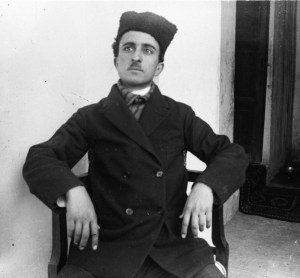
We present this work in honor of the poet’s 125th birthday.
Nima Yooshij Persian 1895 – 1960
A night of deep darkness.
On a branch of the old fig tree
A frog croaks without cease,
Predicting a storm, a deluge,
and I am drowned in fear.
It is night,
And with night the world seems
like a corpse in the grave;
And in fear I say to myself:
‘What if torrential rain falls everywhere?’
‘What if the rain does not stop
until the earth sinks into the water
like a small boat?’
In this night of awful darkness
Who can say in what state we will be
when dawn breaks?
Will the morning light make
the frightening face of the storm
disappear?
From the garden of Heaven a western breeze
Blows through the leaves of my garden of earth;
With a love like a huri I’ld take mine ease,
And wine! bring me wine, the giver of mirth!
To-day the beggar may boast him a king,
His banqueting-hall is the ripening field,
And his tent the shadow that soft clouds fling.
A tale of April the meadows unfold—
Ah, foolish for future credit to slave,
And to leave the cash of the present untold!
Build a fort with wine where thy heart may brave
The assault of the world; when thy fortress falls,
The relentless victor shall knead from thy dust
The bricks that repair its crumbling walls.
Trust not the word of that foe in the fight!
Shall the lamp of the synagogue lend its flame
To set thy monastic torches alight?
Drunken am I, yet place not my name
In the Book of Doom, nor pass judgment on it;
Who knows what the secret finger of Fate
Upon his own white forehead has writ!
And when the spirit of Hafiz has fled,
Follow his bier with a tribute of sighs;
Though the ocean of sin has closed o’er his head,
He may find a place in God’s Paradise.
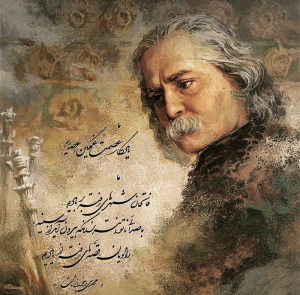
We present this work in honor of the 30th anniversary of the poet’s death.
Mehdi Akhavan-Sales Persian 1929 – 1990
The stone lay there like a mountain
and we sat here a weary bunch
women, men, young, old
all linked together
at the ankles, by a chain.
You could crawl to whomever your heart desired
as far as you could drag your chain.
We did not know, nor did we ask
was it a voice in our nightmare and weariness
or else, a herald from an unknown corner,
it spoke:
“The stone lying there holds a secret
inscribed on it by wise men of old.”
Thus spoke the voice over and again
and, as a wave recoiling on itself
retreated in the dark
and we said nothing
and for some time we said nothing.
Afterwards, only in our looks
many doubts and queries spoke out
then nothing but the ambush of weariness, oblivion
and silence, even in our looks
and the stone lying there.
One night, moonlight pouring damnation on us
and our swollen feet itching
one of us, whose chain was the heaviest
damned his ears and groaned: “I must go”
and we said, fatigued: “Damn our ears
damn our eyes, we must go.”
and we crawled up to where the stone lay one of us, whose chain was looser
climbed up and read:
“He shall know my secret
who turns me over!”
With a singular joy we repeated this dusty secret
under our breath as if it were a prayer
and the night was a glorious stream filled with moonlight.
One… two… three… heave-ho!
One… two… three… once more!
sweating sad, cursing, at times even crying
again…one…two…three…thus many times
hard was our task, sweet our victory
tired but happy, we felt a familiar joy
soaring with delight and ecstasy.
One of us, whose chain was lighter
saluted all, then climbed the stone
wiped the dirt-caked inscription and mouthed the words
(we were impatient)
wetted his lips (and we did the same)
and remained silent
cast a glance at us and remained silent
read again, his eyes fixed, his tongue dead
his gaze drifting over a far away unknown
we yelled to him”
“Read!” he was speechless
“Read it to us!” he stared at us in silence
after a time
he climbed down, his chain clanking
we held him up, lifeless as he was
we sat him down
he cursed our hands and his
“What did you read? huh?”
He swallowed and said faintly:
“The same was written:
“He shall know my secret
who turns me over!”
We sat
and
stared at the moon and the bright night
and the night was a sickly stream.




 Poets Corner