from Safahat

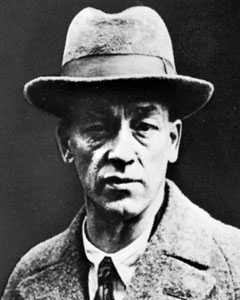
Mehmet Akif Ersoy
Turkish
1873 – 1936


Does a great nation think it is a blessing
To be captive of a person by your order o God?
Does a sword of oppression to burn and destroy the world
Attack like this by your command o God?
Your fury let oppressors do what they want
Even conscience will say with despair there is no divine justice.
Thousands of sparkling sighs raise to heavens
Heavens only repeat the raising sighs
On one side houses of thousands of poors are burning
On the other side the light of millions of youngsters is faded
A stricken mother whose hand is on her chest
Moans because she buried her son into black soil.
Many unfortunate people cry losing their honor
In order to eat a handful of bread.
Thousands of orphans bowed their heads down
Families who lost their homes look for a shelter.
Oppressed people complains, oppressors are in regret
Bloody murderer is drowned in the blood of his victims.
Don´t you think the world scene famous with showing
—Sick, stricken, naked, miserable, paralyzed, incapable
Poor, unworthy, cruel, troubled, captived people,
Unfortunately all this endless crowd—
Presents a bloody watch o God?

About Love of Barbarians

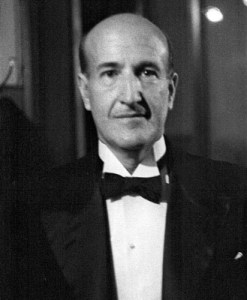
Luis Benitez
Argentine
b. 1956


The opposite seeks the opposite
and the drop of black
grows within white
until turning white into black
and conversely the drop becomes white

We all want the opposite
Which incarnates in front of you
Once in a while
And brings its exotic religion its idea of the subject
Its distractions its apparent cruelty
The little care with which it handles the most precious gifts
The offers and presents we devoted
Before
To our own fetich
Such was our donation
Barbarians have the candor of what we were
That which has never grown in them
Or has never been attempted

They are what was possible for us to be today and did not prosper
Therefore the tenderness the zeal the interest we feel
For its apparent clumsiness
A constant lack of consideration

Our consolation when their actions kill us
is contemplating them kindly
And caressing or at least trying to do so

The destroying brutality
that when rebuked
they sincerely do not understand
As they would not understand if in front of them we wept
The why of all those tears they feel innocent
They are indeed, ours is the tragedy of understanding
That we can do nothing
Either for love or for hatred to redeem the creature
From its rude condition

This is of all gifts perhaps the rarest
Our gods have given us
Our non-existing gods

There are also those barbarians who resemble us
But they are not us beware of them above all
They are the most dangerous they are those who really
Reach your heart
With their deceits of which they are of course
Utterly innocent

But nothing changes barbarians

And when their fierceness appears expressing their “meanness”
Their “violence” their “impiety” their fastidious extreme negligence
They are already within us and it is late
Very late for everything
And they will never leave that
Which their unskilfulness their unconscious malice conquered
And also their dexterity
Widely acquired
In combat against other barbarians

We will be their success the drop of childish joy
Which lasts for a day
The lonely boasting which soon disperses
Ours will be the ruins the venerated broken statues
We sold at market price for their sake
Nothing or almost nothing is worth anything from us among barbarians
And ours will be the night where something will burn
Eternally in flames forever
For the love of barbarians

Shantytown Removal

In honor of the Day of Reconciliation, we present this work by one of the most legendary voices of the South African conflict.

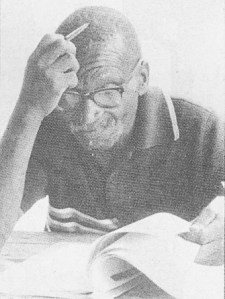
Modikwe Dikobe
South African
b. 1913


I shall never forget that winter morning
A rainy November morning
They dismantled our shantytown
Mindless of sleeping souls
Fast asleep as of anaesthesia.

Unforeseen convey headlights
Heading to our shantytown
Motionless as of a ghost
Returning to its grave in early morning.

Morena! I thought I was dreaming
At the bank of the Klip River
Sprawled on the bank; demobbed soldiers
To demob our peaceful camp
In the name of human rights
In the year of the allied nations.

O! Merciful Lord
Am I sleeping in the open
As in Lombardy estate
In that year of the King’s visit,
Or is it a repetition of demobbed soldiers
On the banks of Canada stream,
Or just a deranged mind?

A stinking lavatory hole there,
A heap of rubbish here,
A stray dog there
It’s all that is left.
In twice a big town
Housing a thousand souls
With its own administration.

I, alone, with a wife and child,
Am left in this ruin
Once, the pride of my administration,
Whipped away are those
Who vowed: ‘We stand by our leader’
Left in the mercy of the documents.

Powerless, hopeless, I lead nobody
I am unfeathered
Left wingless
Dumfounded.
South, West, we are being driven in circles
Spanning in confusion
A mine dump, head-gear, mine column, a lake,
A river bend; seamlessly flowing
Not as I saw it on demobbed day.

The Ancient Elf

James Stephens
Irish
1880 – 1950


I am the maker,
The builder, the breaker,
The eagle-winged helper,
The speedy forsaker!

The lance and the lyre,
The water, the fire,
The tooth of oppression,
The lip of desire!

The snare and the wing,
They honey, the sting!
When you seek for me—look
For a different thing!

I, careless and gay,
Never mean what I say,
For my thoughts and my eyes
Look the opposite way!

No Star

Vicente Aleixandre
Spanish
1898 – 1984


Who said that a body
carved from kisses shines
resplendently, an orb
of happiness? Oh star of mine,
descend! May your light finally
be flesh, be body, here upon
the grass. May I at last
possess you, throbbing in the reeds,
star fallen to the earth,
who for my love would sacrifice
your blood or gleam. No, never,
heavenly one! Here, humble
and tangible, the earth awaits you.
Here, a man loves you.

You Foolish Men

In honor of the Day of the Virgin of Guadalupe, we present this work by one of Mexico’s premier colonial poets.

Sor Juana Inés de la Cruz
Mexican
1651 – 1695


You foolish men who lay
the guilt on women,
not seeing you’re the cause
of the very thing you blame;

if you invite their disdain
with measureless desire
why wish they well behave
if you incite to ill.

You fight their stubbornness,
then, weightily,
you say it was their lightness
when it was your guile.

In all your crazy shows
you act just like a child
who plays the bogeyman
of which he’s then afraid.

With foolish arrogance
you hope to find a Thais
in her you court, but a Lucretia
when you’ve possessed her.

What kind of mind is odder
than his who mists
a mirror and then complains
that it’s not clear.

Their favour and disdain
you hold in equal state,
if they mistreat, you complain,
you mock if they treat you well.

No woman wins esteem of you:
the most modest is ungrateful
if she refuses to admit you;
yet if she does, she’s loose.

You always are so foolish
your censure is unfair;
one you blame for cruelty
the other for being easy.

What must be her temper
who offends when she’s
ungrateful and wearies
when compliant?

But with the anger and the grief
that your pleasure tells
good luck to her who doesn’t love you
and you go on and complain.

Your lover’s moans give wings
to women’s liberty:
and having made them bad,
you want to find them good.

Who has embraced
the greater blame in passion?
She who, solicited, falls,
or he who, fallen, pleads?

Who is more to blame,
though either should do wrong?
She who sins for pay
or he who pays to sin?

Why be outraged at the guilt
that is of your own doing?
Have them as you make them
or make them what you will.

Leave off your wooing
and then, with greater cause,
you can blame the passion
of her who comes to court?

Patent is your arrogance
that fights with many weapons
since in promise and insistence
you join world, flesh and devil.

Dark Pines Under Water

Gwendolyn MacEwen
Canadian
1941 – 1987

This land like a mirror turns you inward
And you become a forest in a furtive lake;
The dark pines of your mind reach downward,
You dream in the green of your time,
Your memory is a row of sinking pines.

Explorer, you tell yourself, this is not what you came for
Although it is good here, and green;
You had meant to move with a kind of largeness,
You had planned a heavy grace, an anguished dream.

But the dark pines of your mind dip deeper
And you are sinking, sinking, sleeper
In an elementary world;
There is something down there and you want it told.

The Blessed

We present this work in honor of the poet’s 125th birthday.

Gertrud Kolmar
German
1894 – 1943


I am in the darkness and alone.
In front of me stands the door.
When I open it, I am bathed in light.
There are a father, a mother and sister,
A dog, which, dumb, still barks in friendliness.

How can I lie, and how can I say
That I, hidden there in darkness, have not come to harm them?
I drag myself over the threshold.

Snow blossoms in my eyes.
I saw him bowing to me courteously;
How much that hurt me.

How could my heart find peace,
When round it raced the voice of the old man?
I live in coldness.

I dried my tears and went
To where the man was eating with his family.
It was so calm and loving a reception.

I felt the violins sounding inside me
At first, so sweetly, so gently.
They will never sound again, when I have finished.

Fear drenched my hands.
Beneath me I could almost taste my womb.
A sneer seemed to say: ‘Have you no shame?
What have you done with the wedding-ring on your finger?
Terrible thief, where did you hide your courage?
Does the nakedness of my right hand mean so little to me?’

I felt so poor and naked.
I wriggled in my chair
And trembled to think what I must do.

Pity clawed at my heart and shook my body
Like a tree in a winter field blown by the wind
Shedding leaves.

I told myself it was time to go,
Scolding my wan, faded self for my little worries.
Pleased with myself again, I steeled myself for the torture.

The joy of it! Oh, how I want to be
Just like an animal and be happy again!
I sharpen my claws with a knife.

It is still night, and that thing called shame,
I may not let it show itself.
I know the train that tears through the woods.

I go out to the unfeeling rails.
Weary, I am glad to go to bed,
Running across two flat sticks of iron.

Butchered to Make a Dutchman’s Holiday

We present this work in honor of the poet’s 155th birthday.

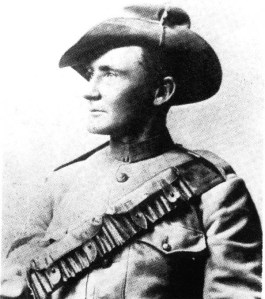
Harry ‘Breaker’ Morant
Australian
1864 – 1902


In prison cell I sadly sit,
A dammed crestfallen chappie,
And own to you I feel a bit—
A little bit—unhappy.

It really ain’t the place nor time
To reel off rhyming diction ;
But yet we’ll write a final rhyme
While waiting crucifixion.

No matter what end they decide
Quick-lime? or boiling oil? sir
We’ll do our best when crucified
To finish off in style, sir !

But we bequeath a parting tip
For sound advice of such men
Who come across in transport ship
To polish off the Dutchmen.

If you encounter any Boers
You really must not loot ‘em,
And, if you wish to leave these shores,
For pity’s sake, don’t shoot ‘em.

And if you’d earn a D.S.O.,
Why every British sinner
Should know the proper way to go
Is: Ask the Boer to dinner.

Let’s toss a bumper down our throat
Before we pass to heaven,
And toast: “The trim-set petticoat
We leave behind in Devon.”