My friend has fled! alas, my friend has fled,
And left me nought but tears and pain behind!
Like smoke above a flame caught by the wind,
So rose she from my breast and forth she sped.
Drunk with desire, I seized Love’s cup divine,
But she that held it poured the bitter wine
Of Separation into it and fled.
The hunter she, and I the helpless prey;
Wounded and sick, round me her toils she drew,
My heart into a sea of sorrow threw,
Bound up her camel loads and fled away.
Fain had I laid an ambush for her soul,
She saw and vanished, and the timid foal,
Good Fortune, slipped the rein and would not stay.
My heart was all too narrow for my woe,
And tears of blood my weeping eyes have shed,
A crimson stream across the desert sped,
Rising from out my sad heart’s overflow.
She knew not what Love’s meanest slave can tell:
“‘Tis sweet to serve!” but threw me a Farewell,
Kissing my threshold, turned, and cried “I go!”
In the clear dawn, before the east was red,
Before the rose had torn her veil in two,
A nightingale through Hafez’ garden flew,
Stayed but to fill its song with tears, and fled.
We present this work in honor of International Day of the World’s Indigenous Peoples.
Oodgeroo Noonuccal Australian 1920 – 1993
They came in to the little town
A semi-naked band subdued and silent
All that remained of their tribe.
They came here to the place of their old bora ground
Where now the many white men hurry about like ants.
Notice of the estate agent reads: ‘Rubbish May Be Tipped Here’.
Now it half covers the traces of the old bora ring.
‘We are as strangers here now, but the white tribe are the strangers.
We belong here, we are of the old ways.
We are the corroboree and the bora ground,
We are the old ceremonies, the laws of the elders.
We are the wonder tales of Dream Time, the tribal legends told.
We are the past, the hunts and the laughing games, the wandering camp fires.
We are the lightening bolt over Gaphembah Hill
Quick and terrible,
And the Thunderer after him, that loud fellow.
We are the quiet daybreak paling the dark lagoon.
We are the shadow-ghosts creeping back as the camp fires burn low.
We are nature and the past, all the old ways
Gone now and scattered.
The scrubs are gone, the hunting and the laughter.
The eagle is gone, the emu and the kangaroo are gone from this place.
The bora ring is gone.
The corroboree is gone.
And we are going.’
We present this work in honor of the 45th anniversary of the poet’s death.
Rosario Castellanos Mexican 1925 – 1974
We kill what we love. What’s left
Was never alive.
No one else is close. What is forgotten,
What else is absent or less, hurts no one else.
We kill what we love. Enough of drawing a choked breath
Through someone else’s lung!
There is not air enough for both of us. And the earth will not hold
Both our bodies
And our ration of hope is small
And pain cannot be shared.
Man is an animal of solitudes,
A deer that bleeds as it flees
With an arrow in its side.
Ah, but hatred with its insomniac
Glass eyes; its attitude
Of menace and repose.
The deer goes to drink and a tiger
Is reflected in the water.
The deer drinks the water and the image. And becomes
-before he is devoured – (accomplice, fascinated)
his enemy.
We give life only to what we hate.
Always be drunk.
That’s it!
The great imperative!
In order not to feel
Time’s horrid fardel
bruise your shoulders,
grinding you into the earth,
Get drunk and stay that way.
On what?
On wine, poetry, virtue, whatever.
But get drunk.
And if you sometimes happen to wake up
on the porches of a palace,
in the green grass of a ditch,
in the dismal loneliness of your own room,
your drunkenness gone or disappearing,
ask the wind,
the wave,
the star,
the bird,
the clock,
ask everything that flees,
everything that groans
or rolls
or sings,
everything that speaks,
ask what time it is;
and the wind,
the wave,
the star,
the bird,
the clock
will answer you:
“Time to get drunk!
Don’t be martyred slaves of Time,
Get drunk!
Stay drunk!
On wine, virtue, poetry, whatever!”
In honor of Civic Day, we present this work by one of Canada’s most important poets.
Robert Service Canadian 1874 – 1958
The cruel war was over — oh, the triumph was so sweet!
We watched the troops returning, through our tears;
There was triumph, triumph, triumph down the scarlet glittering street,
And you scarce could hear the music for the cheers.
And you scarce could see the house-tops for the flags that flew between;
The bells were pealing madly to the sky;
And everyone was shouting for the Soldiers of the Queen,
And the glory of an age was passing by.
And then there came a shadow, swift and sudden, dark and drear;
The bells were silent, not an echo stirred.
The flags were drooping sullenly, the men forgot to cheer;
We waited, and we never spoke a word.
The sky grew darker, darker, till from out the gloomy rack
There came a voice that checked the heart with dread:
“Tear down, tear down your bunting now, and hang up sable black;
They are coming — it’s the Army of the Dead.”
They were coming, they were coming, gaunt and ghastly, sad and slow;
They were coming, all the crimson wrecks of pride;
With faces seared, and cheeks red smeared, and haunting eyes of woe,
And clotted holes the khaki couldn’t hide.
Oh, the clammy brow of anguish! the livid, foam-flecked lips!
The reeling ranks of ruin swept along!
The limb that trailed, the hand that failed, the bloody finger tips!
And oh, the dreary rhythm of their song!
“They left us on the veldt-side, but we felt we couldn’t stop
On this, our England’s crowning festal day;
We’re the men of Magersfontein, we’re the men of Spion Kop,
Colenso — we’re the men who had to pay.
We’re the men who paid the blood-price. Shall the grave be all our gain?
You owe us. Long and heavy is the score.
Then cheer us for our glory now, and cheer us for our pain,
And cheer us as ye never cheered before.”
The folks were white and stricken, and each tongue seemed weighted with lead;
Each heart was clutched in hollow hand of ice;
And every eye was staring at the horror of the dead,
The pity of the men who paid the price.
They were come, were come to mock us, in the first flush of our peace;
Through writhing lips their teeth were all agleam;
They were coming in their thousands — oh, would they never cease!
I closed my eyes, and then — it was a dream.
There was triumph, triumph, triumph down the scarlet gleaming street;
The town was mad; a man was like a boy.
A thousand flags were flaming where the sky and city meet;
A thousand bells were thundering the joy.
There was music, mirth and sunshine; but some eyes shone with regret;
And while we stun with cheers our homing braves,
O God, in Thy great mercy, let us nevermore forget
The graves they left behind, the bitter graves.
We present this work in honor of National Coast Guard Day.
Henry Wadsworth Longfellow American 1807 – 1882
The tide rises, the tide falls,
The twilight darkens, the curlew calls;
Along the sea-sands damp and brown
The traveler hastens toward the town,
And the tide rises, the tide falls.
Darkness settles on roofs and walls,
But the sea, the sea in darkness calls;
The little waves, with their soft, white hands
Efface the footprints in the sands,
And the tide rises, the tide falls.
The morning breaks; the steeds in their stalls
Stamp and neigh, as the hostler calls;
The day returns, but nevermore
Returns the traveler to the shore.
And the tide rises, the tide falls.
Amyntas led me to a Grove,
Where all the Trees did shade us;
The Sun it self, though it had Strove,
It could not have betray’d us:
The place secur’d from humane Eyes,
No other fear allows.
But when the Winds that gently rise,
Doe Kiss the yielding Boughs.
Down there we satt upon the Moss,
And id begin to play
A Thousand Amorous Tricks, to pass
The heat of all the day.
A many Kisses he did give:
And I return’d the same
Which made me willing to receive
That which I dare not name.
His Charming Eyes no Aid requir’d
To tell their softning Tale;
On her that was already fir’d
‘Twas easy to prevaile.
He did but Kiss and Clasp me round,
Whilst those his thoughts Exprest:
And lay’d me gently on the Ground;
Ah who can guess the rest?
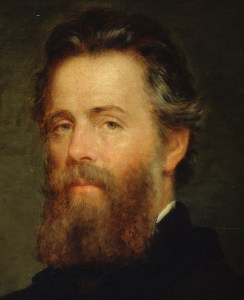
We present this work in honor of the poet’s 200th birthday.
Herman Melville American 1819 – 1891
Skimming lightly, wheeling still,
The swallows fly low
Over the field in clouded days,
The forest-field of Shiloh—
Over the field where April rain
Solaced the parched ones stretched in pain
Through the pause of night
That followed the Sunday fight
Around the church of Shiloh—
The church so lone, the log-built one,
That echoed to many a parting groan
And natural prayer
Of dying foemen mingled there—
Foemen at morn, but friends at eve—
Fame or country least their care:
(What like a bullet can undeceive!)
But now they lie low,
While over them the swallows skim,
And all is hushed at Shiloh.