With Pure Virtue’s Hand

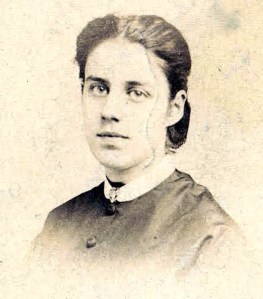
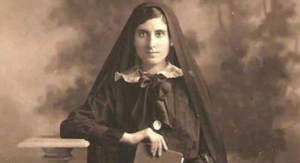
Aisha Taymur
Egyptian
1840 – 1902


With pure virtue’s hand I guard the might of my hijāb
and with faultless self-shielding, among my peers I rise
With my thoughts taking fire and my gift for sharp critique
I have brought my poet’s skills to new and perfect highs
I composed poetry expressing an assemblage:
before me, women sheltered, most noble, esteemed, wise
I uttered my verses just as light and playful speech
yet the eloquence of books and logic I much prize
Mahdī’s daughter, Laylā—these are my choice models
as with innate acuity my best thoughts I poetize
How superb these ladies are! A noble weave indeed
in women and in maidens the men do recognize
Given precious pearls of mind, a poet like Khansa’
wanders rocky paths and for a brother, frantic, cries
From the brow of my notebooks I fashioned my mirror
and of ink’s jet-black traces I created my dyes
How often my fingertip adorns my paper’s cheeks
with script’s downy touch or the skin of my youth’s sighs
The candles of my intellect sent their brilliance far,
as the scent of my words perfumed dear ones’ garden skies
Women of great splendor wrapped in shawls of logic fine:
and their envy my presence or my absence defies
In sentiment’s assembly my tresses I undid:
those of goodly lineage their symbols will surmise
The arts of my eloquence, my mind I protected:
talisman dear, hijab’s amulet: danger denies
My literature and my learning did me no harm
save in making me the finest flower of minds wise
Solitary bower, scarf’s knot, are no affliction
nor my gown’s cut nor proud and strong guarded paradise
My bashfulness, no blockade to keep me from the heights
nor could the veil’s lowering o’er my ringlets disguise
the wager’s arena though the horsemen’s ambitions
from the hardships of the race suffered demise
No! my might is my repose, my knightly prowess lies
in the beauty of my striving: finest goals I prize
Not to mention a secret whose essence is sheltered
though word spread far to strangers of its rarity and size
Like musk it is sealed in the drawers of treasuries:
but the fragrance of its sweetness spreads in saffron sighs
Or like the seas as they embraced hidden gemlike pearls:
when the hands of seekers touch, the touch will paralyze
Desiring to obtain and to have those lovely pearls,
what troubling trials these divers brave, deeds that sense defies!
World-renowned amber agreed to give pearls protection:
its nature is recited in every book one buys
So I touch my fire to the wick in the lamp of skills
granted me by holy God, gifts of the Giver Wise
Mririda

In honor of the Moroccan holiday, Enthronement, we present this work by one of the great Berber poets.

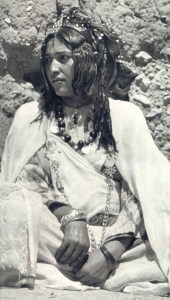
Mririda n’Ait Attik
Moroccan
c. 1900 – c. 1940’s


People called me Mririda, Mririda,
Mririda, the gaile rennet of meadows…
With eyes of gold…
But the rennet’s white chest I do not have
Nor do I have her green tunic.
Yet, like her, I have my ‘zrarit’, my ‘zrarit’
Which reach the sheep-folds
My ‘zrarit’, my ‘zrarit’
Of which people talk in the entire valley
And even on the other sides of the mountains.
My “zrarit” which marvel, which arouse desire…
Because ever since my first steps in the fields,
I slowly took the agile rennet in my hands,
And long pressed her white chest onto mine,
And then onto my maiden lips.
That is how the rennet gave me the marvelous virtue
Of the baraka which makes her sing
A song so clear, so vibrant, so pure
In the Summer nights bathed by the moon,
A song like crystal,
Like the clear noise of an anvil
In the resonant air that precedes rain…
And thanks to the gift that Mririda gave me
They call me: Mririda, Mririda…
He who takes me will feel
My heart beating in his hand
As I often felt under my fingers
The crazy heart-beats of the rennet.
In the nights bathed by the moon
He will call me Mririda, Mririda,
The soft nickname that is so dear to me
For him I will release my sharp ‘zrarit’,
My strident, prolonged ‘zrarit’,
That men admire and women envy,
And such that the valley has never witnessed…

Preoccupation

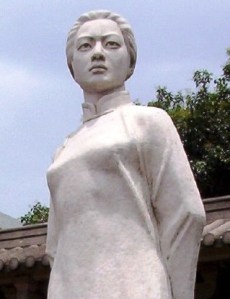
Qiu Jin
Chinese
1875 – 1907


Sun and moon have no light left, earth is dark;
Our women’s world is sunk so deep, who can help us?
Jewelry sold to pay this trip across the seas,
Cut off from my family I leave my native land.
Unbinding my feet I clean out a thousand years of poison,
With heated heart arouse all women’s spirits.
Alas, this delicate kerchief here
Is half stained with blood, and half with tears.

Pied Beauty

We present this work in honor of the poet’s 175th birthday.

Gerard Manley Hopkins
English
1844 – 1889


Glory be to God for dappled things—
For skies of couple-colour as a brinded cow;
For rose-moles all in stipple upon trout that swim;
Fresh-firecoal chestnut-falls; finches’ wings;
Landscape plotted and pieced—fold, fallow, and plough;
And all trades, their gear and tackle and trim.

All things counter, original, spare, strange;
Whatever is fickle, freckled (who knows how?)
With swift, slow; sweet, sour; adazzle, dim;
He fathers-forth whose beauty is past change:
Praise Him.

Wisdom

We present this work in honor of the poet’s 235th birthday.

Denis Davydov
Russian
1784 – 1839


While honouring the grape’s ruby nectar,
All sportingly, laughingly gay;
We determined — I, Silvia, and Hector,
To drive old dame Wisdom away.

“O my children, take care,” said the beldame,
“Attend to these counsels of mine:
Get not tipsy! for danger is seldom
Remote from the goblet of wine.”

“With thee in his company, no man
Can err,” said our wag with a wink;
“But come, thou good-natured old woman,
There’s a drop in the goblet — and drink!”

She frowned — but her scruples soon twisting,
Consented: — and smilingly said:
“So polite — there’s indeed no resisting,
For Wisdom was never ill-bred.”

She drank but continued her teaching:
“Let the wise from indulgence refrain;”
And never gave over her preaching,
But to say, “Fill the goblet again.”

And she drank, and she totter’d, but still she
Was talking and shaking her head:
Muttered “temperance” – “prudence” –
until she Was carried by Love to bed.

Requiem for the Croppies

Seamus Heaney
Irish
1939 – 2013


The pockets of our greatcoats full of barley…
No kitchens on the run, no striking camp…
We moved quick and sudden in our own country.
The priest lay behind ditches with the tramp.
A people hardly marching… on the hike…
We found new tactics happening each day:
We’d cut through reins and rider with the pike
And stampede cattle into infantry,
Then retreat through hedges where cavalry must be thrown.
Until… on Vinegar Hill… the final conclave.
Terraced thousands died, shaking scythes at cannon.
The hillside blushed, soaked in our broken wave.
They buried us without shroud or coffin
And in August… the barley grew up out of our grave.

The Young Captive

We present this work in honor of the 225th anniversary of the poet’s death.

André Chénier
French
1762 – 1794


“The corn in peace fills out its golden ear;
Through the long summer days, the flowers without a fear
Drink in the strength of the noon.
And I, a flower like them, as young, as fair, as pure,
Though at the present hour some trouble I endure,
I would not die so soon!

“No, let the stoic heart call upon Death as kind!
For me, I weep and hope; before the bitter wind
I bend like some lithe palm.
If there be long, sad days, others are bright and fleet;
Alas! what honeyed draught holds nothing but the sweet?
What sea is ever calm?

“And still within my breast nestles illusion bright;
In vain these prison walls shut out the noonday light;
Fair Hope has lent me wings.
So from the fowler’s net, again set free to fly,
More swift, more joyous, through the summer sky,
Philomel soars and sings.

“Is it my lot to die? In peace I lay me down,
In peace awake again, a peace nor care doth drown,
Nor fell remorse destroy.
My welcome shines from every morning face,
And to these downcast souls my presence in this place
Almost restores their joy.

“The voyage of life is but begun for me,
And of the landmarks I must pass, I see
So few behind me stand.
At life’s long banquet, now before me set,
My lips have hardly touched the cup as yet
Still brimming in my hand.

“I only know the spring; I would see autumn brown;
Like the bright sun, that all the seasons crown,
I would round out my year.
A tender flower, the sunny garden’s boast,
I have but seen the fires of morning’s host;
Would eve might find me here!

“O Death, canst thou not wait? Depart from me, and go
To comfort those sad hearts whom pale despair, and woe,
And shame, perchance have wrung.
For me the woods still offer verdant ways,
The Loves their kisses, and the Muses praise:
I would not die so young!”

Thus, captive too, and sad, my lyre none the less
Woke at the plant of one who breathed its own distress,
Youth in a prison cell;
And throwing off the yoke that weighed upon me too,
I strove in all the sweet and tender words I knew
Her gentle grief to tell.

Melodious witness of my captive days,
These rhymes shall make some lover of my lays
Seek the maid I have sung.
Grace sits upon her brow, and all shall share,
Who see her charms, her grief and her despair:
They too “must die so young”!

Magpies

Judith Wright
Australian
1915 – 2000


Along the road the magpies walk
with hands in pockets, left and right.
They tilt their heads, and stroll and talk.
In their well-fitted black and white.

They look like certain gentlemen
who seem most nonchalant and wise
until their meal is served – and then
what clashing beaks, what greedy eyes!

But not one man that I have heard
throws back his head in such a song
of grace and praise – no man nor bird.
Their greed is brief; their joy is long.
For each is born with such a throat
as thanks his God with every note.

News of Your Death

In honor of the Egyptian holiday, Revolution Day, we present this work by one of Egypt’s greatest living poets.

Iman Mersal
Egyptian
b. 1966


I will receive your death
as the last wrong you committed against me.
I will not feel relief as you’d hoped.
And I will firmly believe
that you have denied me the opportunity
to diagnose the tumors
that lay dormant between us.
In the morning
I may be surprised by my puffed eyelids
and that the stoop in my back

has gotten sharper.

The New Colossus

We present this work in honor of the poet’s 170th birthday.

Emma Lazarus
American
1849 – 1887


Not like the brazen giant of Greek fame,
With conquering limbs astride from land to land;
Here at our sea-washed, sunset gates shall stand
A mighty woman with a torch, whose flame
Is the imprisoned lightning, and her name
Mother of Exiles. From her beacon-hand
Glows world-wide welcome; her mild eyes command
The air-bridged harbor that twin cities frame.
“Keep, ancient lands, your storied pomp!” cries she
With silent lips. “Give me your tired, your poor,
Your huddled masses yearning to breathe free,
The wretched refuse of your teeming shore.
Send these, the homeless, tempest-tost to me,
I lift my lamp beside the golden door!”