We present this work in honor of the poet’s 125th birthday.
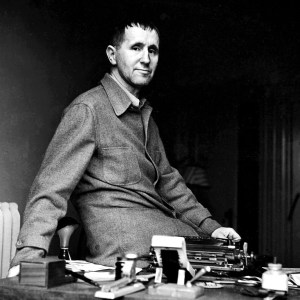
Bertolt Brecht German 1898 – 1956
When the Regime ordered that books with dangerous teachings Should be publicly burnt and everywhere Oxen were forced to draw carts full of books To the funeral pyre, an exiled poet, One of the best, discovered with fury, when he studied the list Of the burned, that his books Had been forgotten. He rushed to his writing table On wings of anger and wrote a letter to those in power, Burn me, he wrote with hurrying pen, burn me! Do not treat me in this fashion. Don’t leave me out. Have I not Always spoken the truth in my books? And now You treat me like a liar! I order you: Burn me!
We present this work in honor of the poet’s 100th birthday.
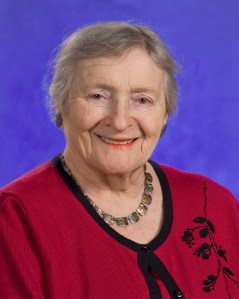
Chava Rosenfarb Canadian 1923 – 2011
I would sew a dress for you, my child, out of tulle made of spring’s joyful green, and gladly crown your head with a diadem made of the sunniest smiles ever seen.
I would fit out your feet with a pair of crystal-like, weightless, dance-ready shoes, and let you step out of the house with bouquets, bright with the promise of pinks and of blues.
But outside it is cold and dreary, my child, the wanton winds lurking unbridled and wild. They will mangle the dress of joy into shreds and sweep the sun’s smiling crown off your head,
Shatter to dust the translucent glass of your shoes and bury in mud the dreams of pinks and of blues. From far away I can hear you call me and moan: “Mother, mother, why did you leave me alone?”
So perhaps I should sew a robe for you, my child, out of the cloak of my old-fashioned pain, and alter my hat of experience for you to shelter you from the ravaging rain?
On your feet I would put my own heavy boots, the soles studded with spikes from my saviourless past and guide your way through the door with a torchlight of wisdom I’ve saved till this hour of dusk.
But outside it is cold and dreary, my child. The wanton winds lurking unbridled and wild will rip up the robe sewn with outdated thread, bare your chest to all danger, to fear bare your head.
The heavy boots will sink in the swamp and will drown, the light of wisdom mocked by the laugh of a clown. From afar I hear you call me and moan: “Mother, mother, why did you leave me alone?”
What a wretched seamstress your mother is— Can’t sew a dress for her child! All she does is prick her clumsy fingers, cross-stitching her soul, while her eyes go blind.
The only thing that I can sew for you, my sweet, my golden child, is a cotton shift of the love I store in my heart. The only thing I can give to light your way are my tears of blessing; I have nothing more.
So I must leave you outside, my child, and leave you there alone. Perhaps dressed in clothing of love you will learn better how to go from home. So I sit here and sew and sew, while in my heart I hope and pray— my hands, unsteady, tremble; my mind, distracted, gone astray.
These unshaped islands, on the sawyer’s bench, Wait for the chisel of the mind, Green canyons to the south, immense and passive, Penetrated rarely, seeded only By the deer-culler’s shot, or else in the north Tribes of the shark and the octopus, Mangroves, black hair on a boxer’s hand.
The founding fathers with their guns and bibles, Botanist, whaler, added bones and names To the land, to us a bridle As if the id were a horse: the swampy towns Like dreamers that struggle to wake,
Longing for the poets’ truth And the lover’s pride. Something new and old Explores its own pain, hearing The rain’s choir on curtains of grey moss Or fingers of the Tasman pressing On breasts of hardening sand, as actors Find their own solitude in mirrors,
As one who has buried his dead, Able at last to give with an open hand.
As I upon my pallet lie, The greatest grief I know Is thinking when I said “Good-bye” To the breast I’m loving so.
In spite of all the woes I feel Upon that parting thought, At times my memories reveal The mighty joys you brought. So let the world a-whispering go To tell why here I lie; Because they know I’ve said “Good-bye” To the breast I’m loving so.
I languish but I let none hear How deep my sorrows are, Although my griefs are quite as near As your sweet balm is far. And if it be the end they show And death is coming nigh, While living, let me say “Good-bye” To the breast I’m loving so.
I become light; you become light; Neither are you from you, nor I from me; we have ripened into one blood…
—One dead, how will death be split into two corpses?
—It is one corpse.
—What if the kin fought to fill two dust holes with one dust gathered by love in the prostration of passion?
—Soft is the clay step in the clay; beneath us the earth gathers into a carpet, dust flinging upon dust; and in the passion prostration the blood of the man prostrating does not reveal the blood of the woman prostrator; one blood runs aground in the darkness of the earth beneath the hand of God, then tossed by the wind in the hand of omnipotence; it rises lightly, taking its course in the radiant mystery of its nocturnal journeys, largely, as the frame of the universe exacts, narrower than the sigh of spirit in spirit.
Between heavens and earth the wind was tempted by us, for it steps along our steps, and we step along its steps…
Who buys my thoughts Buys not a cup of honey That sweetens every taste; He buys the throb, Of Young Africa’s soul, The soul of teeming millions, Hungry, naked, sick, Yearning, pleading, waiting.
Buys not false pretence Of oracles and tin gods; He buys the thoughts Projected by the mass Of restless youths who are born Into deep and clashing cultures, Sorting, questioning, watching.
Who buys my thoughts Buys the spirit of the age, The unquenching fire that smoulders And smoulders In every living heart That’s true and noble or suffering; It burns all o’er the earth, Destroying, chastening, cleansing.




 Poets Corner