With the first pale glimmer,
Of the morning red,
Polly woke delighted
And flew out of bed.
To the door she hurried,
Never stopped for clothes,
Though Jack Frost’s cold fingers
Nipt her little toes.
There it hung! the stocking,
Long and blue and full;
Down it quickly tumbled
With a hasty pull.
Back she capered, laughing,
Happy little Polly;
For from out the stocking
Stared a splendid dolly!
Next, what most she wanted,
In a golden nut,
With a shining thimble,
Scissors that would cut;
Then a book all pictures,
“Children in the Wood.”
And some scarlet mittens
Like her scarlet hood.
Next a charming jump-rope,
New and white and strong;
(Little Polly’s stocking
Though small was very long,)
In the heel she fumbled,
“Something soft and warm,”
A rainbow ball of worsted
Which could do no harm.
In the foot came bon-bons,
In the toe a ring,
And some seeds of mignonette
Ready for the spring.
There she sat at daylight
Hugging close dear dolly;
Eating, looking, laughing,
Happy little Polly!
O come to Craigie Hill, lassie,
The sweetest joys are there;
The bloom is on the whin, lassie,
And ilka scene is fair;
The laverock’s in the lift, lassie,
Warbling its merry lay,
As if to wile us forth, lassie,
To spend the happy day.
What signifies the toun, lassie,
Wi’ a’ its empty show?
It canna yield the joy, lassie,
That nature’s charms bestow,
E’en thw wee flower on the brae, lassie,
Unheeded though it be,
To gentle hearts like thine, lassie,
A pure delight can gie.
We’ll blithely climb the hill, lassie,
And frae its brow survey
Around us wood and ;awn, lassie,
In simmer’s rich array;
Or, by the crystal well, lassie,
That skinkles doun below,
We’ll wander ‘mang the flowers, lassie,
That there in beauty blow.
That spot is dear to me, lassie,
And sacred aye shall be,
For there thy peerless charms, lassie,
First knit my heart to thee.
Then come, oh come, wi’ me, lassie,
Amang theses scenes we’ll rove,
And there enjoy ance mair, lassie,
The dear delights of love.
July sun burns down on the sandy beaches
lashed by the breakers of the angry sea,
and in their turbulence the arrogant waters
pit their harsh roar against the ardent rays.
You flow softly in the pleasant shade
shed for you by the branchy mangrove-tree:
and on the mossy carpet spangled o’er
with sweet spring flowers your sleeping pools repose.
You frolic in the grots your banks recess
among the vast wood’s mahoes and cotton-trees,
and murmur tranquilly beneath the palms
slenderly mirrored in your crystal wave.
This heavenly Eden that here the coast secludes
is sheltered from the sun’s candescent rays;
its light falls warm and gentle through the trees
and takes a green tinge from their spreading boughs.
Here all is hush of sweet unnumbered murmurs,
the whisper softly flowing of your waters,
the growing plant, the music of the birds,
the sighing breeze and rocking of the branches.
The flowers flaunt that from your canopy hang
in countless garlands to adorn your brow,
and the huge lotus, springing from your bed,
with its fresh clusters bends towards you too.
The papaw-tree stoops quivering to your lap,
the mango with its gold and carmine drupes.
And in the poplars the gay parrot flutters
with the harsh pecker and the tuneful linnet.
Sometimes your glassy sheen is struck to foam
on every side by your dark wantoning nymphs;
you fondle them with many a secret clasp
and languidly receive their loving kisses.
And when the sun is hidden by the palms
and in your wilding temple darkness gathers,
the birds salute you with their parting songs
borne by the last breath of the wind away.
Night falls warm; already the white moon
hangs shining in the midst of sapphire sky,
and in your wildwood all is rapt and stilled
and on your margins all begins to sleep.
Then in your sandy bed, bemused, beneath
the melancholy mantle of the palms,
scarcely illumined by the silver light
of the great star of night, you also sleep.
Thus soft you glide; and neither the faint stir
of boats and oars disturb your rest, nor yet
the sudden leaping of the fish that flies
in fear towards the rocks the fisher shuns;
nor the chirp of crickets from the creeks,
nor the snails’ roundelay upon the air,
nor the curassow, whose plaintive cries
distract the cayman’s sleep among the reeds.
What time the fireflies with gleaming dust
sprinkle the shady herbage of the canes
and the dark mallows of the springing cotton
that grows in the ditch, amid the stalky maize.
And the maiden in the cabin, rocking
on the light hammock languid to and fro,
sings the samba’s saddening lullaby
and singing sighs and sighing ever sings.
But of a sudden from the shore a harp
sounds on the air with urgent clanging strings,
tumultuous prelude to the flower of songs,
the sweet malaguena that makes glad the heart.
Then from the villages hard upon the harp
the joyous throng begins to scour the woods,
and soon upon your margin all is joy
and dance and song and love and merriment.
So haste away the brief unheeded hours.
And from the torpor of your gentle dreams
you hearken to your dark enticing daughters
intoning to the moon their hymns of love.
The nestling birds are tremulous with joy;
the opening magnolias shed their nectar;
the zephyrs wake and seem to sigh; your waters
feel how they palpitate within their bed.
Alas! in these hours when burning sleeplessness
revives the memory of blessings gone,
who does not seek the absent love’s soft breast
whereon to press his lips and lay his head?
The palms together twine; caressing light
evinces dismal darkness from your bed;
the flowers flood the breezes with their sweets. . . .
The soul alone feels its sad solitude!
Farewell, quiet stream; the doles of sorrow
do not grieve your green and smiling banks;
for they are for the lonely rocks alone,
lashed by the breakers of the angry sea.
The moon sleeps mirrored in your crystal waters
that overlap your shrubby banks and rock
the bluey sedges and green galingale
drooping now in drowsiness again.
You flow softly in the pleasant shade
shed for you by the branchy mangrove-tree;
and on the mossy carpet spangled o’er
with sweet spring flowers your sleeping pools repose.
In honor of the Russian holiday, Defense of the Fatherland Day, we present this work by the foremost Russian literary figure of the early 19th century.
Vasily Zhukovsky Russian 1783 – 1852
Driven by misfortune’s whirlwind,
Having neither oar nor rudder,
By a storm my bark was driven
Out upon the boundless sea.
“midst black clouds a small star sparkled;
“Don’t conceal yourself!” I cried;
But it disappeared, unheeding;
And my anchor was lost, too.
All was clothed in gloomy darkness;
Great swells heaved all round;
In the darkness yawned the depths
I was hemmed in by cliffs.
“There’s no hope for my salvation!”
I bemoaned, with heavy spirit…
Madman! Providence
Was your secret helmsman.
With a hand invisible,
‘midst the roaring waves,
Through the gloomy, veiled depths
Past the terrifying cliffs,
My all-powerful savior guided me.
Then-all’s quiet ! gloom has vanished;
I behold a paradisical realm…
Three celestial angels.
Providence – O, my protector!
My dejected groaning ceases;
On my knees, in exaltation,
On their image I did gaze.
Who could sing their charm?
Or their power o’er the soul?
All around them holy innocence
And an aura divine.
A delight as yet untasted –
Live and breathe for them;
Take into my soul and heart
All their words and glances sweet.
O fate! I’ve but one desire:
Let them sample every blessing;
Vouchsafe them delight – me suffering;
Only let me die before they do.
What! would you have the fatal sister lend
an ear to sorrow’s pleas? Vain intercession!
Rabble of spectres, get you to your dens!
Separated brother was from brother!
To sit us down at table it is too late;
to get us gone with you it is too soon!
For you, unhappy ones, no longer burns
a single log upon the hearth; no do
I see that any cup awaits your kisses.
A sigh goes after you, a sigh, no more!
Peace be with your going; and may fortune
not bar the way to your retreat to light.
I hate the sepulcher, changed to the cradle
of a vile insect or a venomous snake,
where the sun never rises, nor the moon.
May among your bones a rose take root,
reigned over by the painted butterfly,
and with its fragrance permeate the dew.
Hearken fearless to the impious thunder:
and smile in contemplation, near at hand,
of a stream swollen, overflowing with life.
To get us gone with you it is too soon!
Let her consent at least, the Furious One,
to wait until the cup slips from our hand.
Why, more swiftly still alas! than you,
why does she strip us of existence bare?
From one she steals his forehead’s ornament,
another with her rude hand bends in twain:
some she envelops in a yellow veil:
and others in their entrails feel a claw
that rends, and in their veins an icy cold.
Alas! the spring will come again and find
sorrow in our gates, and lamentation.
And we shall watch the feasters from without.
Perhaps for one the hour has come to go!
The throng of spectres watches for his going.
The course that we are setting, do you know
for what port it is bound? The tomb. Our ship
already founders. Shivered, the mast falls.
Some lie drifting in the waters, dying.
Others commit them to the fragile raft;
and for him who climbed into the shrouds
hope’s despairing light still gutters on,
while wind and wave concert their batteries
and the implacable sky lets loose its bolts.
The flames mount to the lowering of the pennons,
unknown to all save to the bird of rapine,
the sullen west and monsters of the deep.
What is our life but an ill-fashioned vase
whose worth is but the worth of the desire
shut up in it by nature and by chance?
When I see it spilt by age I know
that in the hand of the wise earth alone
it can receive new form and new employ.
Life is not life, but prison, in which want
and pain and lamentation pine in vain;
pleasure flown, who is afraid of death?
Mother nature, there are no more flowers
along the slow paths of my stumbling feet.
I was born without hope or fear;
fearless and hopeless I return to thee.
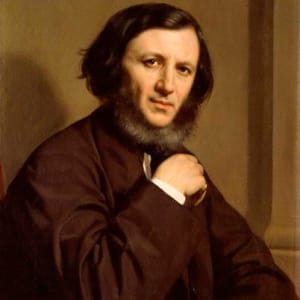
That’s my last Duchess painted on the wall,
Looking as if she were alive. I call
That piece a wonder, now: Frà Pandolf’s hands
Worked busily a day, and there she stands.
Will ‘t please you sit and look at her? I said
‘Frà Pandolf’ by design, for never read
Strangers like you that pictured countenance,
The depth and passion of its earnest glance,
But to myself they turned (since none puts by
The curtain I have drawn for you, but I)
And seemed as they would ask me, if they durst,
How such a glance came there; so, not the first
Are you to turn and ask thus. Sir, ‘t was not
Her husband’s presence only, called that spot
Of joy into the Duchess’ cheek: perhaps
Frà Pandolf chanced to say, ‘Her mantle laps
Over my lady’s wrist too much,’ or ‘Paint
Must never hope to reproduce the faint
Half-flush that dies along her throat:’ such stuff
Was courtesy, she thought, and cause enough
For calling up that spot of joy. She had
A heart—how shall I say?—too soon made glad,
Too easily impressed; she liked whate’er
She looked on, and her looks went everywhere.
Sir, ‘t was all one! My favour at her breast,
The dropping of the daylight in the West,
The bough of cherries some officious fool
Broke in the orchard for her, the white mule
She rode with round the terrace—all and each
Would draw from her alike the approving speech,
Or blush, at least. She thanked men,—good! but thanked
Somehow—I know not how—as if she ranked
My gift of a nine-hundred-years-old name
With anybody’s gift. Who’d stoop to blame
This sort of trifling? Even had you skill
In speech—(which I have not)—to make your will
Quite clear to such an one, and say, ‘Just this
Or that in you disgusts me; here you miss,
Or there exceed the mark’—and if she let
Herself be lessoned so, nor plainly set
Her wits to yours, forsooth, and made excuse,
—E’en then would be some stooping; and I choose
Never to stoop. Oh, sir, she smiled, no doubt,
Whene’er I passed her; but who passed without
Much the same smile? This grew; I gave commands;
Then all smiles stopped together. There she stands
As if alive. Will ‘t please you rise? We’ll meet
The company below then. I repeat,
The Count your master’s known munificence
Is ample warrant that no just pretence
Of mine for dowry will be disallowed;
Though his fair daughter’s self, as I avowed
At starting, is my object. Nay, we’ll go
Together down, sir. Notice Neptune, though,
Taming a sea-horse, thought a rarity,
Which Claus of Innsbruck cast in bronze for me!
We present this work in honor of the poet’s 155th birthday.
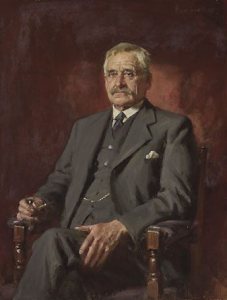
Banjo Paterson Australian 1864 – 1941
I had written him a letter which I had, for want of better
Knowledge, sent to where I met him down the Lachlan, years ago,
He was shearing when I knew him, so I sent the letter to him,
Just ‘on spec’, addressed as follows, ‘Clancy, of The Overflow’.
And an answer came directed in a writing unexpected,
(And I think the same was written with a thumb-nail dipped in tar)
‘Twas his shearing mate who wrote it, and verbatim I will quote it:
‘Clancy’s gone to Queensland droving, and we don’t know where he are.’
In my wild erratic fancy visions come to me of Clancy
Gone a-droving ‘down the Cooper’ where the Western drovers go;
As the stock are slowly stringing, Clancy rides behind them singing,
For the drover’s life has pleasures that the townsfolk never know.
And the bush hath friends to meet him, and their kindly voices greet him
In the murmur of the breezes and the river on its bars,
And he sees the vision splendid of the sunlit plains extended,
And at night the wond’rous glory of the everlasting stars.
I am sitting in my dingy little office, where a stingy
Ray of sunlight struggles feebly down between the houses tall,
And the foetid air and gritty of the dusty, dirty city
Through the open window floating, spreads its foulness over all
And in place of lowing cattle, I can hear the fiendish rattle
Of the tramways and the ‘buses making hurry down the street,
And the language uninviting of the gutter children fighting,
Comes fitfully and faintly through the ceaseless tramp of feet.
And the hurrying people daunt me, and their pallid faces haunt me
As they shoulder one another in their rush and nervous haste,
With their eager eyes and greedy, and their stunted forms and weedy,
For townsfolk have no time to grow, they have no time to waste.
And I somehow rather fancy that I’d like to change with Clancy,
Like to take a turn at droving where the seasons come and go,
While he faced the round eternal of the cash-book and the journal–
But I doubt he’d suit the office, Clancy, of ‘The Overflow’.
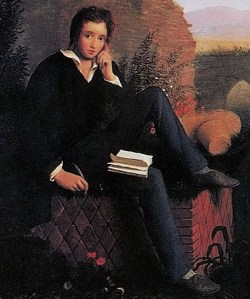
I met a traveller from an antique land
Who said: “Two vast and trunkless legs of stone
Stand in the desert . . . Near them, on the sand,
Half sunk, a shattered visage lies, whose frown,
And wrinkled lip, and sneer of cold command,
Tell that its sculptor well those passions read
Which yet survive, stamped on these lifeless things,
The hand that mocked them, and the heart that fed:
And on the pedestal these words appear:
‘My name is Ozymandias, king of kings:
Look on my works, ye Mighty, and despair!’
Nothing beside remains. Round the decay
Of that colossal wreck, boundless and bare
The lone and level sands stretch far away.”


 Poets Corner