‘Twas summer,— through the opening grass
The joyous flowers upsprang,
The birds in all their different tribes
Loud in the woodlands sang:
Then forth I went, and wandered far
The wide green meadow o’er;
Where cool and clear the fountain play’d,
There strayed I in that hour.
Roaming on, the nightingale
Sang sweetly in my ear;
And, by the greenwood’s shady side,
A dream came to me there;
Fast by the fountain, where bright flowers
Of sparkling hue we see,
Close sheltered from the summer heat,
That vision came to me.
All care was banished, and repose
Came o’er my wearied breast;
And kingdoms seemed to wait on me,
For I was with the blest.
Yet, while it seemed as if away
My spirit soared on high,
And in the boundless joys of heaven
Was wrapt in ecstacy,
E’en then, my body revelled still
In earth’s festivity;
And surely never was a dream
So sweet as this to me.
Thus I dream’d on, and might have dwelt
Still on that rapturous dream,
When, hark! a raven’s luckless note
(Sooth, ‘twas a direful scream,)
Broke up the vision of delight,
Instant my joy was past:
O, had a stone but met my hand,
That hour had been his last…
We present this work in honor of the 20th anniversary of the poet’s death.
A.D. Hope Australian 1907 – 2000
Gliding through the still air, he made no sound;
Wing-shod and deft, dropped almost at her feet,
And searched the ghostly regiments and found
The living eyes, the tremor of breath, the beat
Of blood in all that bodiless underground.
She left her majesty; she loosed the zone
Of darkness and put by the rod of dread.
Standing, she turned her back upon the throne
Where, well she knew, the Ruler of the Dead,
Lord of her body and being, sat like stone;
Stared with his ravenous eyes to see her shake
The midnight drifting from her loosened hair,
The girl once more in all her actions wake,
The blush of colour in her cheeks appear
Lost with her flowers that day beside the lake.
The summer flowers scattering, the shout,
The black manes plunging down to the black pit —
Memory or dream? She stood awhile in doubt,
Then touched the Traveller God’s brown arm and met
His cool, bright glance and heard his words ring out:
“Queen of the Dead and Mistress of the Year!”
— His voice was the ripe ripple of the corn;
The touch of dew, the rush of morning air —
“Remember now the world where you were born;
The month of your return at last is here.”
And still she did not speak, but turned again
Looking for answer, for anger, for command:
The eyes of Dis were shut upon their pain;
Calm as his marble brow, the marble hand
Slept on his knee. Insuperable disdain
Foreknowing all bounds of passion, of power, of art,
Mastered but could not mask his deep despair.
Even as she turned with Hermes to depart,
Looking her last on her grim ravisher
For the first time she loved him from her heart.
In honor of The Twelfth (Battle of the Boyne), we present this work by one of today’s finest exemplars of the Irish spirit.
Derek Mahon Irish b. 1941
There is an old
statue in the courtyard
that weeps, like Niobe, its sorrow in stone.
The griefs of the ages she has made her own.
Her eyes are rain-washed but not hard,
her body is covered in mould,
the garden overgrown.
One by one
the first lights come on,
those that haven’t been on all night.
Christmas, the harshly festive, has come and gone.
No snow, but the rain pours down
in the first hour before dawn,
before daylight.
Swift’s home
for ‘fools and mad’ has become
the administrative block. Much there
has remained unchanged for many a long year —
stairs, chairs, Georgian widows shafting light and dust,
of the satirist;
but the real
hospital is a cheerful
modern extension at the back
hung with restful reproductions of Dufy, Klee and Braque.
Television, Russian fiction, snooker with the staff,
a sifter of Lucozade, a paragraph
of Newsweek or the Daily Mail
are my daily routine
during the festive season.
They don’t lock the razors here
as in Bowditch Hall. We have remained upright —
though, to be frank, the Christmas dinner scene,
with grown men in their festive gear,
was a sobering sight.
I watch the last
planes of the year go past,
silently climbing a cloud-lit sky.
Earth-bound, soon I’ll be taking a train to Cork
and trying to get back to work
at my sea-lit, fort-view desk
in the turf-smoky dusk.
Meanwhile,
next door, a visiting priest
intones to a faithful dormitory.
I sit on my Protestant bed, a make-believe existentialist,
and stare the clouds of unknowing. We style,
as best we may, our private destiny;
or so it seems to me
as I chew my thumb
and try to figure out
what brought me to my present state¬ —
an ‘educated man’, a man of consequence, no bum
but one who has hardly grasped what life is about,
if anything. My children, far away,
don’t know where I am today,
in a Dublin asylum
with a paper whistle and a mince pie,
my bits and pieces making a home from home.
I pray to the rain-clouds that they never come
where their lost father lies; that their mother thrives;
and that I
may measure up to them
before I die.
Soon a new year
will be here demanding, as before,
modest proposals, resolute resolutions, a new leaf,
new leaves. This is the story of my life,
the story of all lives everywhere,
mad fools whatever we are,
in here or out there.
Light and sane
I shall walk down to the train,
into that world whose sanity we know,
like Swift to be a fiction and a show.
The clouds part, the rain ceases, the sun
casts now upon everyone
its ancient shadow.
We present this work in honor of the 110th anniversary of the poet’s death.
Eusebio Lillo Chilean 1826 – 1910
I
The bloody fight has ceased;
and yesterday’s invader is now our brother;
three centuries we washed the affront
fighting in the field of honor.
That who yesterday was a slave
is free and triumphant today;
freedom is the heritage of the brave,
Victory lies shameful to his feet.
II
Rise, Chile, with a spotless forehead;
you conquered your name on the fight;
always noble, constant and courageous
the children of the Cid found you.
May your free calmly crown
the arts, industry and peace,
and may they sing songs of your triumph
to intimidate the daring despot.
III
Your names, brave soldiers
who have been Chile’s mainstay,
they are engraved in our chests;
our children will know them as well.
May they be the death cry
that comes out when we march to the fight,
and ringing in the mouth of the strong
they always make the tyrant tremble.
IV
If the foreign cannon intends
to invade, daring, our people;
let’s draw our arms
and know victory or death.
With its blood the proud Araucanian
inherited its courage to us;
and the sword doesn’t tremble in the hand
of that who defends the honor of Chile.
V
How pure, Chile, is your blue sky
And how pure the breezes that blow across you
And your countryside embroidered with flowers
Is a wonderful copy of Eden
How majestic are the snow-covered mountains
That were given to you by God as protection
And the sea that tranquilly bathes your shores
Promises future splendor for you
VI
That pride, oh, Homeland!, those flowers
growing on your fertile soil,
may they never be stepped on by invaders;
may your shadow cover them with peace.
Our chests will be your bastion
in your name we will know how to win,
or your noble, glorious emblem
will see us fall in the fight.
Beloved Homeland, receive the vows
That Chile gave you on your altars
That you be either the tomb of the free
Or a refuge from oppression
We present this work in honor of the poet’s 55th birthday.
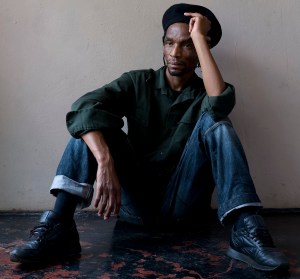
Legeso Rampolokeng South African b. 1965
tattered rain
& i’m navy blue
in the frayed streets
pressure reaching down
& slow magic coming on
drum flute & the night whistle
mute music of torn throats
& then
tongues twisted around on themselves
spew out froth
green
rabid at yellow dusk…
& the night gathers its red soaked apparel
staggers home
Today I drank wine and was drunk
I swear, I cannot hold my tongue
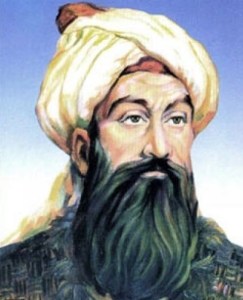
Today I was so pleased with my Dervish
I swear, I forgot all about death
The world appears completely empty
My Dervish brings me pleasure
He is exuberant whenever he loves
I swear, I love my Dervish
The morsel the Dervish proffers is permitted for me
The tavern is my pilgrim‘s kabaa
The barking of the patrolling hounds
I swear, does not block my way
Let the Dervish come and be cross with me
Let my arm embrace his neck
Let the arms that are drawn away be broken
I swear, I cannot withdraw my arm
If I enter his embrace uncovered
If he sleeps and I love silently
If he awakes and he speaks rudely
I swear, I cannot withdraw my hand
I am Latife I am so shameless
I love greatly and I am so brazen
I know nothing of shame and honour
I swear, I will pluck my rose
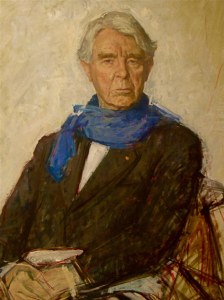
In honor of Independence Day, we present this work by one of the most quintessentially American of all American poets.
Carl Sandburg American 1878 – 1967
I drank musty ale at the Illinois Athletic Club with the millionaire manufacturer of Green River butter one night
And his face had the shining light of an old-time Quaker, he spoke of a beautiful daughter, and I knew he had a peace and a happiness up his sleeve somewhere. Then I heard Jim Kirch make a speech to the Advertising Association on the trade resources of South America.
And the way he lighted a three-for-a-nickel stogie and cocked it at an angle regardless of the manners of our best people,
I knew he had a clutch on a real happiness even though some of the reporters on his newspaper say he is the living double of Jack London’s Sea Wolf.
In the mayor’s office the mayor himself told me he was happy though it is a hard job to satisfy all the office-seekers and eat all the dinners he is asked to eat.
Down in Gilpin Place, near Hull House, was a man with his jaw wrapped for a bad toothache,
And he had it all over the butter millionaire, Jim Kirch and the mayor when it came to happiness.
He is a maker of accordions and guitars and not only makes them from start to finish, but plays them after he makes them.
And he had a guitar of mahogany with a walnut bottom he offered for seven dollars and a half if I wanted it,
And another just like it, only smaller, for six dollars, though he never mentioned the price till I asked him,
And he stated the price in a sorry way, as though the music and the make of an instrument count for a million times more than the price in money.
I thought he had a real soul and knew a lot about God.
There was light in his eyes of one who has conquered sorrow in so far as sorrow is conquerable or worth conquering.
Anyway he is the only Chicago citizen I was jealous of that day.
He played a dance they play in some parts of Italy when the harvest of grapes is over and the wine presses are ready for work.
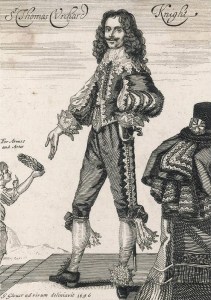
Great Monarch, since the worlds nativity,
No mind, nor body had so divine parts
To grace the State of Sov’rain Majesty,
As hath your Royall person, whose deserts
Soare higher ‘bove the reach of other Kings,
Then the bright Sun transcends terrestriall things.


 Poets Corner